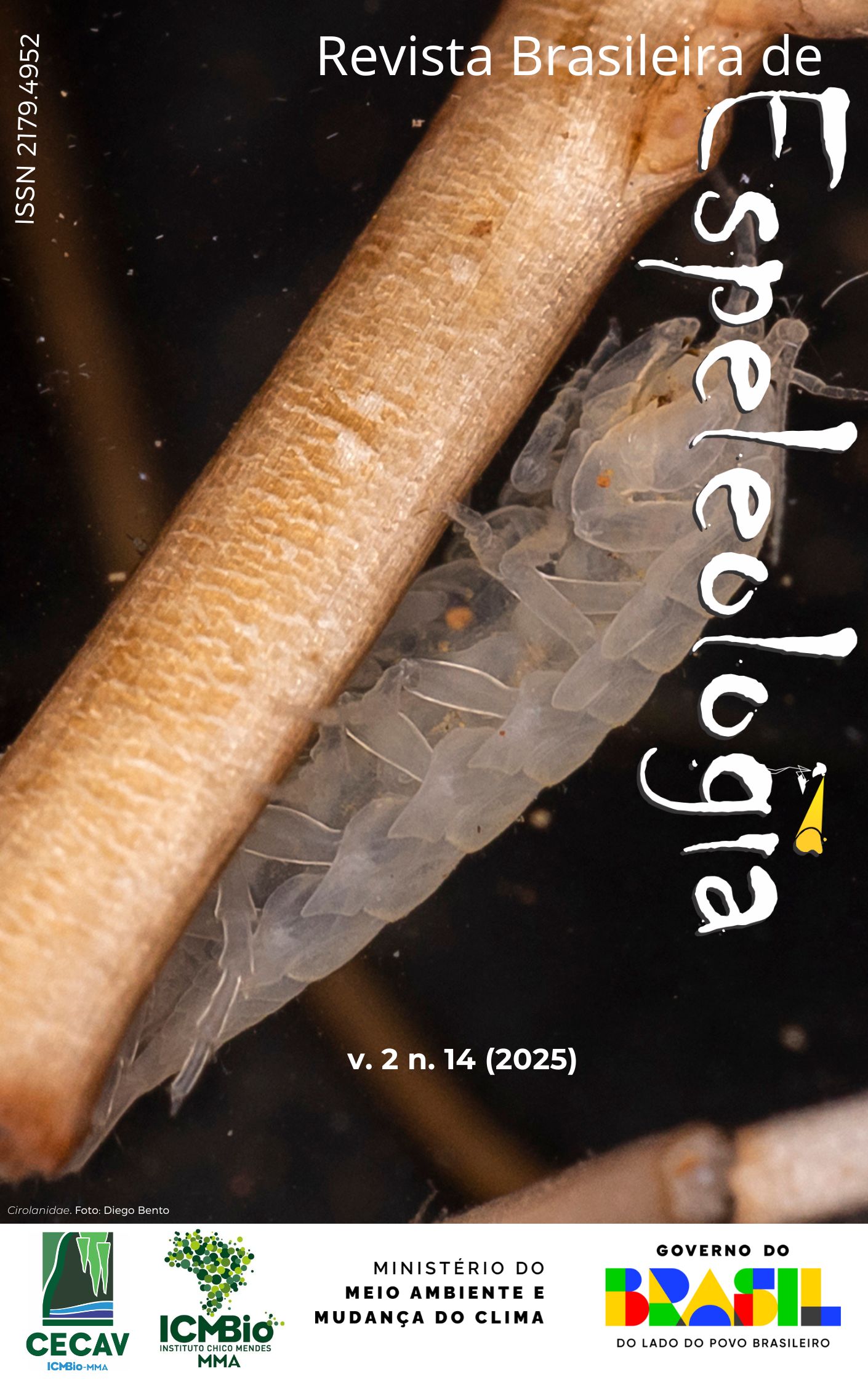
Who´s inside, and who´s outside? Habitat structure determines the richness and composition of invertebrates in quartzite caves and surrounding habitats
DOI:
https://doi.org/10.37002/rbesp.v2i14.2831Palavras-chave:
Invertebrados cavernícolas, Similaridade, Heterogeneidade de habitat, NeotrópicosResumo
Nos últimos anos, estudos têm buscado compreender como as estruturas físicas e ambientais dentro das cavernas influenciam as comunidades de invertebrados. No entanto, ainda há uma escassez de pesquisas que explorem como a composição do substrato e a heterogeneidade do habitat influenciam as comunidades faunísticas em cavernas de quartzito e em áreas epígeas adjacentes, apesar da importância de entender essas relações ecológicas para embasar estratégias eficazes de conservação. Este estudo avaliou a similaridade das comunidades de invertebrados entre cavernas de quartzito e habitats de superfície circundantes, bem como as variáveis ambientais que influenciam a composição e a riqueza faunística. O estudo foi conduzido em três sistemas cavernícolas de quartzito, com amostragens realizadas no interior das cavernas e em zonas epígeas adjacentes. Os resultados revelaram dissimilaridade na composição faunística entre os ambientes subterrâneo e de superfície, enquanto as comunidades dentro das cavernas apresentaram maior similaridade entre si. A substituição de espécies foi identificada como o principal componente da diversidade βsør total entre os dois ambientes. As composições faunísticas distintas observadas são impulsionadas por filtros ambientais, sendo que as condições restritivas das cavernas limitam a colonização e favorecem invertebrados especializados. Além disso, variáveis distintas de substrato emergiram como fator-chave na estruturação das comunidades, com detritos vegetais influenciando a fauna epígea, e guano e substratos inorgânicos estruturando a fauna cavernícola. Esses achados avançam a compreensão da dinâmica dos ecossistemas subterrâneos, destacando a importância das características do habitat na formulação de estratégias de conservação da biodiversidade.
Referências
ANDERSON, M. J.; GORLEY, R. N.; CLARKE, K. R. PERMANOVA+ for PRIMER: Guide to Software and Statistical Methods. Massey University, Albany Campus, Auckland: New Zealand, 2008.
ATAURI, J. A.; DE LUCIO, J. V. The role of landscape structure in species richness distribution of birds, amphibians, reptiles and lepidopterans in Mediterranean landscapes. Landscape ecology, v. 16, p. 147-159, 2001. https://doi.org/10.1023/A:1011115921050
BADINO, G. Underground meteorology – “What’s the weather underground?”. Acta carsologica, v. 39, n. 3, 2010. https://doi.org/10.3986/ac.v39i3.74
BARR JR, T. C. Cave ecology and the evolution of troglobites. In: DOBZHANSKY, T.; HECHT, M. K.; STEERE, W. C. Evolutionary biology. Boston, MA: Springer US, 1968. v. 2, p. 35-102. https://doi.org/10.1007/978-1-4684-8094-8_2
BASELGA, A. Partitioning the turnover and nestedness components of beta diversity. Global ecology and biogeography, v. 19, n. 1, p. 134-143, 2010. https://doi.org/10.1111/j.1466-8238.2009.00490.x
BENTO, D. D. M. et al. Seasonal variations in cave invertebrate communities in the semiarid Caatinga, Brazil. Journal of Cave and Karst Studies, v. 78, n. 2, p. 61-71, 2016. https://doi.org/10.4311/2015LSC0111
CARDOSO, R. C.; FERREIRA, R. L.; SOUZA-SILVA, M. Multi-spatial analysis on cave ecosystems to predict the diversity of subterranean invertebrates. Basic and Applied Ecology, v. 65, p. 111-122, 2022. https://doi.org/10.1016/j.baae.2022.11.007
CARDOSO, R. C.; FERREIRA, R. L.; SOUZA-SILVA, M. Caves’ environmental stability shaping subterranean biodiversity in the neotropics. Acta Oecologica, v. 125, 104036, 2024. https://doi.org/10.1016/j.actao.2024.104036
CLARKE, K. R. Non‐parametric multivariate analyses of changes in community structure. Australian journal of ecology, v. 18, n. 1, p. 117-143, 1993. https://doi.org/10.1111/j.1442-9993.1993.tb00438.x
CLARKE, K. R.; GORLEY, R. N. PRIMER v6: User Manual/Tutorial. Plymouth: PRIMER-E, 2006. 192 p.
CORRÊA-NETO, A.V.; DUTRA, G. A Província Espeleológica Quartzítica Andrelândia, sudeste de Minas Gerais. In: RASTEIRO, M.A.; PEREIRA-FILHO, M. (orgs.) CONGRESSO BRASILEIRO DE ESPELEOLOGIA, 24, 1997. Ouro Preto. Anais... Campinas: SBE, 2017. p.37-43. http://www.cavernas.org.br/anais24cbe/24cbe_037-043.pdf
CRIBARI-NETO, F.; ZEILEIS, A. Beta regression in R. Journal of statistical software, v. 34, p. 1-24, 2010. https://doi.org/10.18637/jss.v034.i02
CULVER, D. C. Cave life: evolution and ecology. Cambridge: Harvard University Press, 1982. https://doi.org/10.4159/harvard.9780674330214.c6
CULVER, D. C.; PIPAN, T. The biology of caves and other subterranean habitats. 2. ed. Oxford: Oxford University Press, 2019.
DERRAIK, J. G. et al. Arthropod morphospecies versus taxonomic species: a case study with Araneae, Coleoptera, and Lepidoptera. Conservation Biology, v. 16, n. 4, p. 1015-1023, 2002. https://doi.org/10.1046/j.1523-1739.2002.00358.x
DERRAIK, J. G. et al. Morphospecies and taxonomic species comparison for Hymenoptera. Journal of Insect Science, v. 10, n. 1, p. 108, 2010. https://doi.org/10.1673/031.010.10801
FERREIRA, R. L. Guano communities. In: WHITE, W. B.; CULVER, D. C. (ed.). Encyclopedia of caves. Cambridge: Academic Press, 2019. p. 474-484. https://doi.org/10.1016/B978-0-12-814124-3.00057-1
FERREIRA, R. L.; MARQUES, M. M. A fauna de artrópodes de serrapilheira de áreas de monocultura com Eucalyptus sp. e mata secundária heterogênea. Anais da Sociedade Entomológica do Brasil, v. 27, p. 395-403, 1998. https://doi.org/10.1590/S0301-80591998000300007
FERREIRA, R. L.; MARTINS, R. P. Mapping subterranean resources: The cave invertebrates distribution as indicator of food availability. Revista Brasileira de Zoociências, v. 11, n. 2, 2009.
FERREIRA, R. L.; MARTINS, R. P. Trophic structure and natural history of bat guano invertebrate communities, with special reference to Brazilian caves. Tropical zoology, v. 12, n. 2, p. 231-252, 1999. https://doi.org/10.1080/03946975.1999.10539391
FOX, J. et al. Package ‘car’. Vienna: R Foundation for Statistical Computing, 2012. 16 p.
FURTADO-OLIVEIRA, L. F. et al. Recreational caving impacts of visitors in a high-altitude cave in Bolivian Andes: main effects on microhabitat structure and faunal distribution. International Journal of Speleology, v. 51, n. 2, p. 2, 2022. https://doi.org/10.5038/1827-806X.51.2.2418
GIBERT, J. Basic attributes of groundwater ecosystems. In: GIBERT, J. et al. (ed.). Groundwater Ecology. San Diego: Academic Press, 2001. p. 39-52.
HARTIG, F. DHARMa: residual diagnostics for hierarchical (Multi-Level/Mixed) regression models (version 0.4.6). R package, 2022.
HUMPHREYS, W. F. Experimental re-establishment of pulse-driven populations in a terrestrial troglobite community. The Journal of Animal Ecology, p. 609-623, 1991. https://doi.org/10.2307/5301
HUXEL, G. R.; MCCANN, K. Food web stability: the influence of trophic flows across habitats. The American Naturalist, v. 152, n. 3, p. 460-469, 1998. https://doi.org/10.1086/286182
LEVENE, H. Robust tests for equality of variances. In: OLKIN, I. (ed.). Contributions to probability and statistics. Stanford: Stanford University Press, 1960. p. 278-292.
LOYOLA, R. D.; BRITO, S. L.; FERREIRA, R. L. Ecosystem disturbances and diversity increase: implications for invertebrate conservation. In: MORENO, C. E.; PÁEZ, R. (ed.). Arthropod diversity and conservation. New York: Springer, 2006. p. 25-42. https://doi.org/10.1007/978-1-4020-5204-0_3
LUNGHI, E.; MANENTI, R.; FICETOLA, G. F. Cave features, seasonality and subterranean distribution of non-obligate cave dwellers. PeerJ, v. 5, e3169, 2017. https://doi.org/10.7717/peerj.3169
MACARTHUR, R. H.; MACARTHUR, J. W. On bird species diversity. Ecology, v. 42, n. 3, p. 594-598, 1961. https://doi.org/10.2307/1932254
MACARTHUR, R.; LEVINS, R. The limiting similarity, convergence, and divergence of coexisting species. The American Naturalist, v. 101, n. 921, p. 377-385, 1967. https://doi.org/10.1086/282505
MAGURRAN, A. E. Ecological diversity and its measurement. New York: Springer Science & Business Media, 2013.
MAGURRAN, A. E.; MCGILL, B. J. (ed.). Biological diversity: frontiers in measurement and assessment. Oxford: OUP Oxford, 2010.
MAMMOLA, S. Finding answers in the dark: caves as models in ecology fifty years after Poulson and White. Ecography, v. 42, n. 7, p. 1331-1351, 2019a. https://doi.org/10.1111/ecog.03905
MAMMOLA, S.; CARDOSO, P.; ANGYAL, D.; BALÁZS, G.; BLICK, T.; BRUSTEL, H. et al. Continental data on cave-dwelling spider communities across Europe (Arachnida: Araneae). Biodiversity Data Journal, v. 7, e38492, 2019b. doi: 10.3897/BDJ.7.e38492
MAMMOLA, S.; PIANO, E.; ISAIA, M. Step back! Niche dynamics in cave-dwelling predators. Acta Oecologica, v. 75, p. 35-42, 2016. https://doi.org/10.1016/j.actao.2016.06.011
MAY, R. M. The search for patterns in the balance of nature: advances and retreats. Ecology, v. 67, n. 5, p. 1115-1126, 1986. https://doi.org/10.2307/1938668
MARCZAK, L. B.; THOMPSON, R. M.; RICHARDSON, J. S. Meta‐analysis: trophic level, habitat, and productivity shape the food web effects of resource subsidies. Ecology, v. 88, n. 1, p. 140-148, 2007. https://doi.org/10.1890/0012-9658(2007)88[140:MTLHAP]2.0.CO;2
MENDES RABELO, L.; SOUZA‐SILVA, M.; LOPES FERREIRA, R. Epigean and hypogean drivers of Neotropical subterranean communities. Journal of Biogeography, v. 48, n. 3, p. 662-675, 2021. https://doi.org/10.1111/jbi.14031
OLIVEIRA, M. P.; FERREIRA, R. L. Extending beyond individual caves: a graph theory approach broadening conservation priorities in Amazon iron ore caves. PeerJ, v. 12, e16877, 2024. https://doi.org/10.7717/peerj.16877
OLIVER, I.; BEATTIE, A. J. Invertebrate morphospecies as surrogates for species: a case study. Conservation Biology, v. 10, n. 1, p. 99-109, 1996. https://doi.org/10.1046/j.1523-1739.1996.10010099.x
PACHECO, G. S.; SOUZA SILVA, M.; CANO, E.; FERREIRA, R. L. The role of microhabitats in structuring cave invertebrate communities in Guatemala. International Journal of Speleology, v. 49, n. 2, p. 8, 2020a. https://doi.org/10.5038/1827-806X.49.2.2333
PACHECO, G. S. M.; DE OLIVEIRA, M. P. A.; CANO, E.; SOUZA SILVA, M.; FERREIRA, R. L. Tourism effects on the subterranean fauna in a Central American cave. Insect Conservation and Diversity, v. 14, n. 3, p. 294-306, 2020b. https://doi.org/10.1111/icad.12451
PACHECO, G. S. M.; SOUZA-SILVA, M.; FERREIRA, R. L. Environmental factors influencing invertebrate communities in caves and surrounding habitats in the Neotropics. Journal of Tropical Ecology, v. 41, e8, 2025. doi:10.1017/S0266467425000082
PELLEGRINI, T.; SALES, L. P.; AGUIAR, P.; FERREIRA, R. L. Linking spatial scale dependence of land-use descriptors and invertebrate cave community composition. Subterranean Biology, v. 18, p. 17-38, 2016. https://doi.org/10.3897/SUBTBIOL.18.8335
PETERSON, B. G.; CARL, P. PerformanceAnalytics: econometric tools for performance and risk analysis. R package, version 2.0.4.P, 2020.
PIANKA, E. R. Convexity, desert lizards, and spatial heterogeneity. Ecology, v. 47, n. 6, p. 1055-1059, 1966. https://doi.org/10.2307/1935656
POULSON, T. L.; WHITE, W. B. The cave environment: limestone caves provide unique natural laboratories for studying biological and geological processes. Science, v. 165, n. 3897, p. 971-981, 1969. DOI:10.1126/science.165.3897.971
PREVIATI, E.; FANO, E. A.; LEIS, M. Arthropods biodiversity in agricultural landscapes: effects of land use and anthropization. Italian Journal of Agronomy, v. 2, n. 2, p. 135-141, 2007. https://doi.org/10.4081/ija.2007.127.
PROUS, X.; FERREIRA, R. L.; JACOBI, C. M. The entrance as a complex ecotone in a Neotropical cave. International Journal of Speleology, v. 44, n. 2, p. 5, 2015. http://dx.doi.org/10.5038/1827-806X.44.2.7
PROUS, X.; FERREIRA, R. L.; MARTINS, R. P. Ecotone delimitation: epigean–hypogean transition in cave ecosystems. Austral Ecology, v. 29, n. 4, p. 374-382, 2004. https://doi.org/10.1111/j.1442-9993.2004.01373.x
R CORE TEAM. R: a language and environment for statistical computing. Vienna, Austria: R Foundation for Statistical Computing, 2025.
RASBAND, W. S. ImageJ64. Bethesda, MD: US National Institutes of Health, 1997.
REIS-VENÂNCIO, P. C.; RABELO, L. M.; PELLEGRINI, T. G.; FERREIRA, R. L. From light to darkness: the duality of influence of habitat heterogeneity on Neotropical terrestrial cave invertebrate communities. Studies on Neotropical Fauna and Environment, v. 59, n. 2, p. 255-264, 2022. https://doi.org/10.1080/01650521.2022.2095832
SCHNEIDER, K.; CHRISTMAN, M. C.; FAGAN, W. F. The influence of resource subsidies on cave invertebrates: results from an ecosystem‐level manipulation experiment. Ecology, v. 92, n. 3, p. 765-776, 2011. https://doi.org/10.1890/10-0157.1
SCHOBER, P.; BOER, C.; SCHWARTE, L. A. Correlation coefficients: appropriate use and interpretation. Anesthesia & Analgesia, v. 126, n. 5, p. 1763-1768, 2018. DOI: 10.1213/ANE.0000000000002864
SHAPIRO, S. S.; WILK, M. B. An analysis of variance test for normality (complete samples). Biometrika, v. 52, n. 3-4, p. 591-611, 1965. https://doi.org/10.1093/biomet/52.3-4.591
SIMON, K. S.; PIPAN, T.; CULVER, D. C. A conceptual model of the flow and distribution of organic carbon in caves. Journal of Cave and Karst Studies, v. 69, n. 2, p. 279-284, 2007.
SKET, B. The nature of biodiversity in hypogean waters and how it is endangered. Biodiversity & Conservation, v. 8, p. 1319-1338, 1999. https://doi.org/10.1023/A:1008916601121
SOUZA, F. L.; MARTINS, F. I.; RAIZER, J. Habitat heterogeneity and anuran community of an agroecosystem in the Pantanal of Brazil. Phyllomedusa: Journal of Herpetology, v. 13, n. 1, p. 41-50, 2014. https://doi.org/10.11606/issn.2316-9079.v13i1p41-50
SOUZA-SILVA, M.; CERQUEIRA, R. F. V.; PELLEGRINI, T. G.; FERREIRA, R. L. Habitat selection of cave-restricted fauna in a new hotspot of subterranean biodiversity in Neotropics. Biodiversity and Conservation, v. 30, p. 4223–4250, 2021. https://doi.org/10.1007/s10531-021-02302-8
SOUZA-SILVA, M.; INIESTA, L. F. M.; FERREIRA, R. L. Cave lithology effect on subterranean biodiversity: a case study in quartzite and granitoid caves. Acta Oecologica, v. 108, 103645, 2020b. https://doi.org/10.1016/j.actao.2020.103645
SOUZA-SILVA, M.; INIESTA, L. F. M.; FERREIRA, R. L. Invertebrates diversity in mountain Neotropical quartzite caves: which factors can influence the composition, richness, and distribution of the cave communities? Subterranean Biology, v. 33, p. 23-43, 2020a. https://doi.org/10.3897/subtbiol.33.46444
SOUZA-SILVA, M.; MARTINS, R. P.; FERREIRA, R. L. Trophic dynamics in a neotropical limestone cave. Subterranean Biology, v. 9, p. 127-138, 2011. https://doi.org/10.3897/subtbiol.9.2515
SOUZA-SILVA, M.; SALVIO, A.; FERREIRA, R. L. Food resource availability in a quartzite cave in the Brazilian Montane Atlantic Forest. Journal of Cave and Karst Studies, v. 75, p. 177–188, 2013. https://dx.doi.org/10.4311/2010JCKS0158
SPRENT, P.; SMEETON, N. C. Applied nonparametric statistical methods. Boca Raton: Chapman and Hall/CRC, 2000. 480 p.
STEIN, A.; GERSTNER, K.; KREFT, H. Environmental heterogeneity as a universal driver of species richness across taxa, biomes and spatial scales. Ecology Letters, v. 17, n. 7, p. 866-880, 2014. https://doi.org/10.1111/ele.12277
TEWS, J.; BROSE, U.; GRIMM, V.; TIELBÖRGER, K.; WICHMANN, M. C.; SCHWAGER, M.; JELTSCH, F. Animal species diversity driven by habitat heterogeneity/diversity: the importance of keystone structures. Journal of Biogeography, v. 31, n. 1, p. 79-92, 2004. https://doi.org/10.1046/j.0305-0270.2003.00994.x
THE JAMOVI PROJECT. Jamovi (version 2.4) [Computer software], 2023.
TRAVASSOS-DE-BRITTO, B.; ROCHA, P. L. B. D. Habitat amount, habitat heterogeneity, and their effects on arthropod species diversity. Ecoscience, v. 20, n. 3, p. 207-214, 2013. https://doi.org/10.2980/20-3-3606
VENARSKY, M. P.; HUNTSMAN, B. M. Food webs in caves. In: Cave ecology, p. 309-328, 2018. https://doi.org/10.1007/978-3-319-98852-8_14
VENARSKY, M. P.; HUNTSMAN, B. M.; HURYN, A. D.; BENSTEAD, J. P.; KUHAJDA, B. R. Quantitative food web analysis supports the energy-limitation hypothesis in cave stream ecosystems. Oecologia, v. 176, p. 859-869, 2014. https://doi.org/10.1007/s00442-014-3042-3
ZAGMAJSTER, M.; MALARD, F.; EME, D.; CULVER, D. C. Subterranean biodiversity patterns from global to regional scales. In: Cave ecology, p. 195-227, 2018. https://doi.org/10.1007/978-3-319-98852-8_9
ZUUR, A. F.; HILBE, J. M.; IENO, E. N. A beginner’s guide to GLM and GLMM with R. Newburgh, UK: Highland Statistics Ltd, 2013.