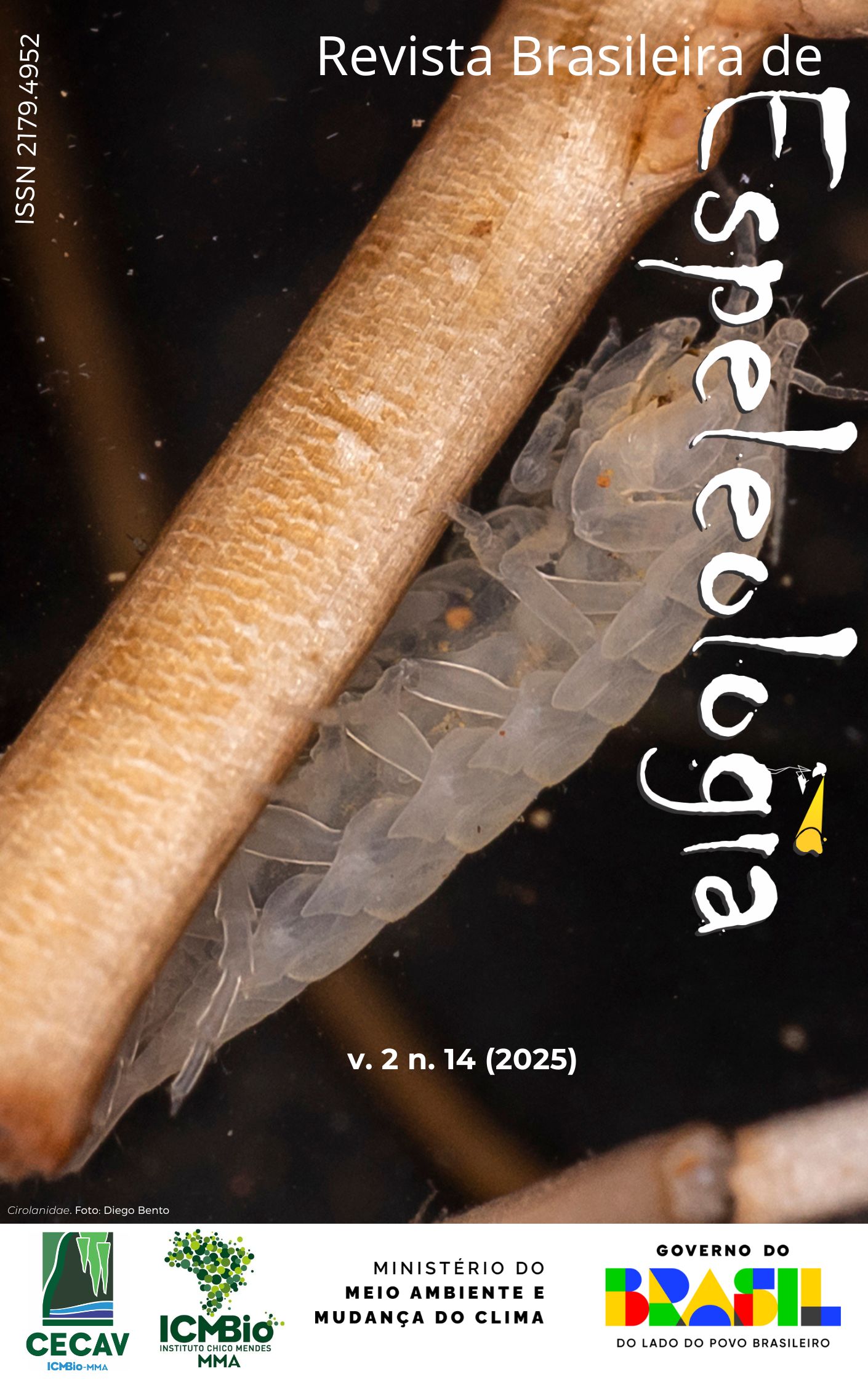
Who's inside, and who's outside? Habitat structure determines the richness and composition of invertebrates in quartzite caves and surrounding habitats.
DOI:
https://doi.org/10.37002/rbesp.v2i14.2831Palabras clave:
Cave invertebrates, Similarity, Habitat heterogeneity, NeotropicsResumen
In recent years, studies have aimed to understand how physical and environmental structures within caves influence invertebrate communities. However, there is still a lack of research exploring how substrate composition and habitat heterogeneity influence faunal communities in quartzite caves and adjacent epigean areas, despite the importance of understanding these ecological relationships to inform effective conservation strategies. This study evaluated the similarity of invertebrate communities between quartzite caves and surrounding surface habitats, as well as the environmental variables influencing faunal composition and richness. The study was conducted across three quartzite cave systems, with sampling carried out within the caves and in adjacent epigean zones. Results revealed dissimilarity in faunal composition between subterranean and surface environments, while communities within caves exhibited higher similarity. Species turnover was identified as the primary component of total βsør-diversity between the two environments. The distinct faunal compositions observed are driven by environmental filters, with restrictive cave conditions limiting colonization and favoring specialized invertebrates. Additionally, distinct substrate variables emerged as a key driver of community structure, with plant debris influencing epigean fauna, and guano and inorganic substrates structuring cave fauna. These findings advance understanding of subterranean ecosystem dynamics, highlighting the importance of habitat features in informing biodiversity conservation strategies.
Citas
ANDERSON, M. J.; GORLEY, R. N.; CLARKE, K. R. PERMANOVA+ for PRIMER: Guide to Software and Statistical Methods. Massey University, Albany Campus, Auckland: New Zealand, 2008.
ATAURI, J. A.; DE LUCIO, J. V. The role of landscape structure in species richness distribution of birds, amphibians, reptiles and lepidopterans in Mediterranean landscapes. Landscape ecology, v. 16, p. 147-159, 2001. https://doi.org/10.1023/A:1011115921050
BADINO, G. Underground meteorology – “What’s the weather underground?”. Acta carsologica, v. 39, n. 3, 2010. https://doi.org/10.3986/ac.v39i3.74
BARR JR, T. C. Cave ecology and the evolution of troglobites. In: DOBZHANSKY, T.; HECHT, M. K.; STEERE, W. C. Evolutionary biology. Boston, MA: Springer US, 1968. v. 2, p. 35-102. https://doi.org/10.1007/978-1-4684-8094-8_2
BASELGA, A. Partitioning the turnover and nestedness components of beta diversity. Global ecology and biogeography, v. 19, n. 1, p. 134-143, 2010. https://doi.org/10.1111/j.1466-8238.2009.00490.x
BENTO, D. D. M. et al. Seasonal variations in cave invertebrate communities in the semiarid Caatinga, Brazil. Journal of Cave and Karst Studies, v. 78, n. 2, p. 61-71, 2016. https://doi.org/10.4311/2015LSC0111
CARDOSO, R. C.; FERREIRA, R. L.; SOUZA-SILVA, M. Multi-spatial analysis on cave ecosystems to predict the diversity of subterranean invertebrates. Basic and Applied Ecology, v. 65, p. 111-122, 2022. https://doi.org/10.1016/j.baae.2022.11.007
CARDOSO, R. C.; FERREIRA, R. L.; SOUZA-SILVA, M. Caves’ environmental stability shaping subterranean biodiversity in the neotropics. Acta Oecologica, v. 125, 104036, 2024. https://doi.org/10.1016/j.actao.2024.104036
CLARKE, K. R. Non‐parametric multivariate analyses of changes in community structure. Australian journal of ecology, v. 18, n. 1, p. 117-143, 1993. https://doi.org/10.1111/j.1442-9993.1993.tb00438.x
CLARKE, K. R.; GORLEY, R. N. PRIMER v6: User Manual/Tutorial. Plymouth: PRIMER-E, 2006. 192 p.
CORRÊA-NETO, A.V.; DUTRA, G. A Província Espeleológica Quartzítica Andrelândia, sudeste de Minas Gerais. In: RASTEIRO, M.A.; PEREIRA-FILHO, M. (orgs.) CONGRESSO BRASILEIRO DE ESPELEOLOGIA, 24, 1997. Ouro Preto. Anais... Campinas: SBE, 2017. p.37-43. http://www.cavernas.org.br/anais24cbe/24cbe_037-043.pdf
CRIBARI-NETO, F.; ZEILEIS, A. Beta regression in R. Journal of statistical software, v. 34, p. 1-24, 2010. https://doi.org/10.18637/jss.v034.i02
CULVER, D. C. Cave life: evolution and ecology. Cambridge: Harvard University Press, 1982. https://doi.org/10.4159/harvard.9780674330214.c6
CULVER, D. C.; PIPAN, T. The biology of caves and other subterranean habitats. 2. ed. Oxford: Oxford University Press, 2019.
DERRAIK, J. G. et al. Arthropod morphospecies versus taxonomic species: a case study with Araneae, Coleoptera, and Lepidoptera. Conservation Biology, v. 16, n. 4, p. 1015-1023, 2002. https://doi.org/10.1046/j.1523-1739.2002.00358.x
DERRAIK, J. G. et al. Morphospecies and taxonomic species comparison for Hymenoptera. Journal of Insect Science, v. 10, n. 1, p. 108, 2010. https://doi.org/10.1673/031.010.10801
FERREIRA, R. L. Guano communities. In: WHITE, W. B.; CULVER, D. C. (ed.). Encyclopedia of caves. Cambridge: Academic Press, 2019. p. 474-484. https://doi.org/10.1016/B978-0-12-814124-3.00057-1
FERREIRA, R. L.; MARQUES, M. M. A fauna de artrópodes de serrapilheira de áreas de monocultura com Eucalyptus sp. e mata secundária heterogênea. Anais da Sociedade Entomológica do Brasil, v. 27, p. 395-403, 1998. https://doi.org/10.1590/S0301-80591998000300007
FERREIRA, R. L.; MARTINS, R. P. Mapping subterranean resources: The cave invertebrates distribution as indicator of food availability. Revista Brasileira de Zoociências, v. 11, n. 2, 2009.
FERREIRA, R. L.; MARTINS, R. P. Trophic structure and natural history of bat guano invertebrate communities, with special reference to Brazilian caves. Tropical zoology, v. 12, n. 2, p. 231-252, 1999. https://doi.org/10.1080/03946975.1999.10539391
FOX, J. et al. Package ‘car’. Vienna: R Foundation for Statistical Computing, 2012. 16 p.
FURTADO-OLIVEIRA, L. F. et al. Recreational caving impacts of visitors in a high-altitude cave in Bolivian Andes: main effects on microhabitat structure and faunal distribution. International Journal of Speleology, v. 51, n. 2, p. 2, 2022. https://doi.org/10.5038/1827-806X.51.2.2418
GIBERT, J. Basic attributes of groundwater ecosystems. In: GIBERT, J. et al. (ed.). Groundwater Ecology. San Diego: Academic Press, 2001. p. 39-52.
HARTIG, F. DHARMa: residual diagnostics for hierarchical (Multi-Level/Mixed) regression models (version 0.4.6). R package, 2022.
HUMPHREYS, W. F. Experimental re-establishment of pulse-driven populations in a terrestrial troglobite community. The Journal of Animal Ecology, p. 609-623, 1991. https://doi.org/10.2307/5301
HUXEL, G. R.; MCCANN, K. Food web stability: the influence of trophic flows across habitats. The American Naturalist, v. 152, n. 3, p. 460-469, 1998. https://doi.org/10.1086/286182
LEVENE, H. Robust tests for equality of variances. In: OLKIN, I. (ed.). Contributions to probability and statistics. Stanford: Stanford University Press, 1960. p. 278-292.
LOYOLA, R. D.; BRITO, S. L.; FERREIRA, R. L. Ecosystem disturbances and diversity increase: implications for invertebrate conservation. In: MORENO, C. E.; PÁEZ, R. (ed.). Arthropod diversity and conservation. New York: Springer, 2006. p. 25-42. https://doi.org/10.1007/978-1-4020-5204-0_3
LUNGHI, E.; MANENTI, R.; FICETOLA, G. F. Cave features, seasonality and subterranean distribution of non-obligate cave dwellers. PeerJ, v. 5, e3169, 2017. https://doi.org/10.7717/peerj.3169
MACARTHUR, R. H.; MACARTHUR, J. W. On bird species diversity. Ecology, v. 42, n. 3, p. 594-598, 1961. https://doi.org/10.2307/1932254
MACARTHUR, R.; LEVINS, R. The limiting similarity, convergence, and divergence of coexisting species. The American Naturalist, v. 101, n. 921, p. 377-385, 1967. https://doi.org/10.1086/282505
MAGURRAN, A. E. Ecological diversity and its measurement. New York: Springer Science & Business Media, 2013.
MAGURRAN, A. E.; MCGILL, B. J. (ed.). Biological diversity: frontiers in measurement and assessment. Oxford: OUP Oxford, 2010.
MAMMOLA, S. Finding answers in the dark: caves as models in ecology fifty years after Poulson and White. Ecography, v. 42, n. 7, p. 1331-1351, 2019a. https://doi.org/10.1111/ecog.03905
MAMMOLA, S.; CARDOSO, P.; ANGYAL, D.; BALÁZS, G.; BLICK, T.; BRUSTEL, H. et al. Continental data on cave-dwelling spider communities across Europe (Arachnida: Araneae). Biodiversity Data Journal, v. 7, e38492, 2019b. doi: 10.3897/BDJ.7.e38492
MAMMOLA, S.; PIANO, E.; ISAIA, M. Step back! Niche dynamics in cave-dwelling predators. Acta Oecologica, v. 75, p. 35-42, 2016. https://doi.org/10.1016/j.actao.2016.06.011
MAY, R. M. The search for patterns in the balance of nature: advances and retreats. Ecology, v. 67, n. 5, p. 1115-1126, 1986. https://doi.org/10.2307/1938668
MARCZAK, L. B.; THOMPSON, R. M.; RICHARDSON, J. S. Meta‐analysis: trophic level, habitat, and productivity shape the food web effects of resource subsidies. Ecology, v. 88, n. 1, p. 140-148, 2007. https://doi.org/10.1890/0012-9658(2007)88[140:MTLHAP]2.0.CO;2
MENDES RABELO, L.; SOUZA‐SILVA, M.; LOPES FERREIRA, R. Epigean and hypogean drivers of Neotropical subterranean communities. Journal of Biogeography, v. 48, n. 3, p. 662-675, 2021. https://doi.org/10.1111/jbi.14031
OLIVEIRA, M. P.; FERREIRA, R. L. Extending beyond individual caves: a graph theory approach broadening conservation priorities in Amazon iron ore caves. PeerJ, v. 12, e16877, 2024. https://doi.org/10.7717/peerj.16877
OLIVER, I.; BEATTIE, A. J. Invertebrate morphospecies as surrogates for species: a case study. Conservation Biology, v. 10, n. 1, p. 99-109, 1996. https://doi.org/10.1046/j.1523-1739.1996.10010099.x
PACHECO, G. S.; SOUZA SILVA, M.; CANO, E.; FERREIRA, R. L. The role of microhabitats in structuring cave invertebrate communities in Guatemala. International Journal of Speleology, v. 49, n. 2, p. 8, 2020a. https://doi.org/10.5038/1827-806X.49.2.2333
PACHECO, G. S. M.; DE OLIVEIRA, M. P. A.; CANO, E.; SOUZA SILVA, M.; FERREIRA, R. L. Tourism effects on the subterranean fauna in a Central American cave. Insect Conservation and Diversity, v. 14, n. 3, p. 294-306, 2020b. https://doi.org/10.1111/icad.12451
PACHECO, G. S. M.; SOUZA-SILVA, M.; FERREIRA, R. L. Environmental factors influencing invertebrate communities in caves and surrounding habitats in the Neotropics. Journal of Tropical Ecology, v. 41, e8, 2025. doi:10.1017/S0266467425000082
PELLEGRINI, T.; SALES, L. P.; AGUIAR, P.; FERREIRA, R. L. Linking spatial scale dependence of land-use descriptors and invertebrate cave community composition. Subterranean Biology, v. 18, p. 17-38, 2016. https://doi.org/10.3897/SUBTBIOL.18.8335
PETERSON, B. G.; CARL, P. PerformanceAnalytics: econometric tools for performance and risk analysis. R package, version 2.0.4.P, 2020.
PIANKA, E. R. Convexity, desert lizards, and spatial heterogeneity. Ecology, v. 47, n. 6, p. 1055-1059, 1966. https://doi.org/10.2307/1935656
POULSON, T. L.; WHITE, W. B. The cave environment: limestone caves provide unique natural laboratories for studying biological and geological processes. Science, v. 165, n. 3897, p. 971-981, 1969. DOI:10.1126/science.165.3897.971
PREVIATI, E.; FANO, E. A.; LEIS, M. Arthropods biodiversity in agricultural landscapes: effects of land use and anthropization. Italian Journal of Agronomy, v. 2, n. 2, p. 135-141, 2007. https://doi.org/10.4081/ija.2007.127.
PROUS, X.; FERREIRA, R. L.; JACOBI, C. M. The entrance as a complex ecotone in a Neotropical cave. International Journal of Speleology, v. 44, n. 2, p. 5, 2015. http://dx.doi.org/10.5038/1827-806X.44.2.7
PROUS, X.; FERREIRA, R. L.; MARTINS, R. P. Ecotone delimitation: epigean–hypogean transition in cave ecosystems. Austral Ecology, v. 29, n. 4, p. 374-382, 2004. https://doi.org/10.1111/j.1442-9993.2004.01373.x
R CORE TEAM. R: a language and environment for statistical computing. Vienna, Austria: R Foundation for Statistical Computing, 2025.
RASBAND, W. S. ImageJ64. Bethesda, MD: US National Institutes of Health, 1997.
REIS-VENÂNCIO, P. C.; RABELO, L. M.; PELLEGRINI, T. G.; FERREIRA, R. L. From light to darkness: the duality of influence of habitat heterogeneity on Neotropical terrestrial cave invertebrate communities. Studies on Neotropical Fauna and Environment, v. 59, n. 2, p. 255-264, 2022. https://doi.org/10.1080/01650521.2022.2095832
SCHNEIDER, K.; CHRISTMAN, M. C.; FAGAN, W. F. The influence of resource subsidies on cave invertebrates: results from an ecosystem‐level manipulation experiment. Ecology, v. 92, n. 3, p. 765-776, 2011. https://doi.org/10.1890/10-0157.1
SCHOBER, P.; BOER, C.; SCHWARTE, L. A. Correlation coefficients: appropriate use and interpretation. Anesthesia & Analgesia, v. 126, n. 5, p. 1763-1768, 2018. DOI: 10.1213/ANE.0000000000002864
SHAPIRO, S. S.; WILK, M. B. An analysis of variance test for normality (complete samples). Biometrika, v. 52, n. 3-4, p. 591-611, 1965. https://doi.org/10.1093/biomet/52.3-4.591
SIMON, K. S.; PIPAN, T.; CULVER, D. C. A conceptual model of the flow and distribution of organic carbon in caves. Journal of Cave and Karst Studies, v. 69, n. 2, p. 279-284, 2007.
SKET, B. The nature of biodiversity in hypogean waters and how it is endangered. Biodiversity & Conservation, v. 8, p. 1319-1338, 1999. https://doi.org/10.1023/A:1008916601121
SOUZA, F. L.; MARTINS, F. I.; RAIZER, J. Habitat heterogeneity and anuran community of an agroecosystem in the Pantanal of Brazil. Phyllomedusa: Journal of Herpetology, v. 13, n. 1, p. 41-50, 2014. https://doi.org/10.11606/issn.2316-9079.v13i1p41-50
SOUZA-SILVA, M.; CERQUEIRA, R. F. V.; PELLEGRINI, T. G.; FERREIRA, R. L. Habitat selection of cave-restricted fauna in a new hotspot of subterranean biodiversity in Neotropics. Biodiversity and Conservation, v. 30, p. 4223–4250, 2021. https://doi.org/10.1007/s10531-021-02302-8
SOUZA-SILVA, M.; INIESTA, L. F. M.; FERREIRA, R. L. Cave lithology effect on subterranean biodiversity: a case study in quartzite and granitoid caves. Acta Oecologica, v. 108, 103645, 2020b. https://doi.org/10.1016/j.actao.2020.103645
SOUZA-SILVA, M.; INIESTA, L. F. M.; FERREIRA, R. L. Invertebrates diversity in mountain Neotropical quartzite caves: which factors can influence the composition, richness, and distribution of the cave communities? Subterranean Biology, v. 33, p. 23-43, 2020a. https://doi.org/10.3897/subtbiol.33.46444
SOUZA-SILVA, M.; MARTINS, R. P.; FERREIRA, R. L. Trophic dynamics in a neotropical limestone cave. Subterranean Biology, v. 9, p. 127-138, 2011. https://doi.org/10.3897/subtbiol.9.2515
SOUZA-SILVA, M.; SALVIO, A.; FERREIRA, R. L. Food resource availability in a quartzite cave in the Brazilian Montane Atlantic Forest. Journal of Cave and Karst Studies, v. 75, p. 177–188, 2013. https://dx.doi.org/10.4311/2010JCKS0158
SPRENT, P.; SMEETON, N. C. Applied nonparametric statistical methods. Boca Raton: Chapman and Hall/CRC, 2000. 480 p.
STEIN, A.; GERSTNER, K.; KREFT, H. Environmental heterogeneity as a universal driver of species richness across taxa, biomes and spatial scales. Ecology Letters, v. 17, n. 7, p. 866-880, 2014. https://doi.org/10.1111/ele.12277
TEWS, J.; BROSE, U.; GRIMM, V.; TIELBÖRGER, K.; WICHMANN, M. C.; SCHWAGER, M.; JELTSCH, F. Animal species diversity driven by habitat heterogeneity/diversity: the importance of keystone structures. Journal of Biogeography, v. 31, n. 1, p. 79-92, 2004. https://doi.org/10.1046/j.0305-0270.2003.00994.x
THE JAMOVI PROJECT. Jamovi (version 2.4) [Computer software], 2023.
TRAVASSOS-DE-BRITTO, B.; ROCHA, P. L. B. D. Habitat amount, habitat heterogeneity, and their effects on arthropod species diversity. Ecoscience, v. 20, n. 3, p. 207-214, 2013. https://doi.org/10.2980/20-3-3606
VENARSKY, M. P.; HUNTSMAN, B. M. Food webs in caves. In: Cave ecology, p. 309-328, 2018. https://doi.org/10.1007/978-3-319-98852-8_14
VENARSKY, M. P.; HUNTSMAN, B. M.; HURYN, A. D.; BENSTEAD, J. P.; KUHAJDA, B. R. Quantitative food web analysis supports the energy-limitation hypothesis in cave stream ecosystems. Oecologia, v. 176, p. 859-869, 2014. https://doi.org/10.1007/s00442-014-3042-3
ZAGMAJSTER, M.; MALARD, F.; EME, D.; CULVER, D. C. Subterranean biodiversity patterns from global to regional scales. In: Cave ecology, p. 195-227, 2018. https://doi.org/10.1007/978-3-319-98852-8_9
ZUUR, A. F.; HILBE, J. M.; IENO, E. N. A beginner’s guide to GLM and GLMM with R. Newburgh, UK: Highland Statistics Ltd, 2013.