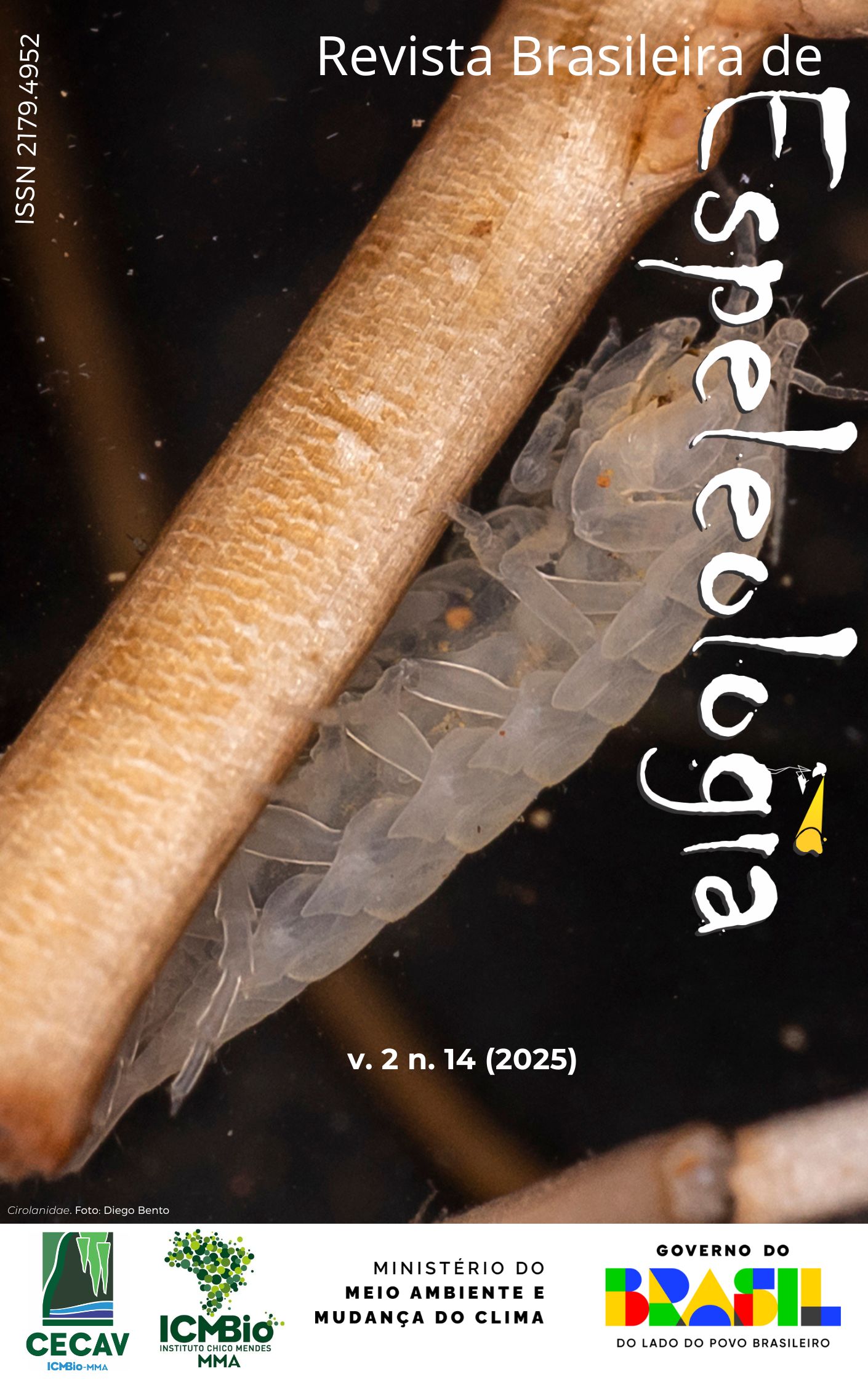
A buried umbrella: historical changes in the landscape surrounding the habitats of threatened troglobitic isopods in Brazil
Keywords:
land use, Spelunconiscus,, mining, caveAbstract
Impacts on karst environments exert particularly severe effects on species restricted to subterranean habitats (troglobites), as disturbances in surface ecosystems are typically transmitted to subterranean compartments. Given the high habitat specificity of these organisms and the extensive alteration of epigean environments, we investigated the potential impacts and pressures affecting 17 troglobitic isopod species of Spelunconiscus, all endemic to the Arcos-Pains-Doresópolis speleological province in southeastern Brazil. To assess temporal landscape changes surrounding the caves inhabited by these species, we delineated 14 drainage areas using the Ottobasin methodology. These areas were analyzed through land-use and land-cover maps derived from Landsat satellite images for the years 1984 and 2019. Subsequently, we ranked the ottobasins according to the degree of anthropogenic impact to guide conservation and management priorities. Among the 14 areas evaluated, 11 exhibited an increase in native vegetation cover. Nevertheless, expansions of mining, agriculture, and silviculture were also detected. The most intense impacts occurred in the upstream sectors of the ottobasins, which exert greater influence on the subterranean environment due to their hydrological connectivity with the caves. The Eden cave ottobasin emerged as the most threatened, combining intense anthropogenic pressure with the highest diversity of endemic troglobites. Prioritizing the protection and conservation of the five most impacted ottobasins would safeguard approximately 60.5% of the troglobitic species recorded in these areas, corresponding to 46% of all troglobitic species in the province. In contrast, extending protection to all 14 ottobasins would ensure the preservation of 76% of the province’s troglobitic fauna.
References
ABELHO, M.; GRAÇA, M. A. S. Effects of eucalyptus afforestation on leaf litter dynamics and macroinvertebrate community structure of streams in Central Portugal. Hydrobiologia, Dordrecht, v. 324, n. 3, p. 195-204, 1996. https://doi.org/10.1007/BF00016391
ANM. Sistema de Informações Geográficas da Mineração – SIGMINE. Brasília, 2021. Disponível em: http://www.anm.gov.br/assuntos/ao-minerador/sigmine.
BRASIL. Decreto nº 6.640 de 07 de novembro de 2008. Brasília, 2008.
CAVALCANTI, L. F.; LIMA, M. F.; MEDEIROS, R. C. S.; MEGUERDITCHIAN, I. Plano de ação nacional para a conservação do patrimônio espeleológico nas áreas cársticas da bacia do rio São Francisco. Brasília: Instituto Chico Mendes de Conservação da Biodiversidade, 2012. 140 p.
CECAV. Cadastro Nacional de Informações Espeleológicas. Brasília, 2021. Disponível em: https://www.icmbio.gov.br/cecav/canie.html.
CONAMA. Conselho Nacional do Meio Ambiente – Ministério do Meio Ambiente. Resolução nº 347, de 10 de setembro de 2004. Brasília, DF, 2004.
CONGALTON, R. G.; GREEN, K. Assessing the accuracy of remotely sensed data: principles and practices. Boca Raton: CRC Press, 2019.
COXON, C. Agriculture and karst. In: VAN BEYNEN, P. E. (ed.). Karst management. Dordrecht: Springer, 2011. p. 103-138.
CULVER, D. C.; PIPAN, T. The biology of caves and other subterranean habitats. Oxford: Oxford University Press, 2019.
DAVIES-COLLEY, R. J.; PAYNE, G. W.; VAN ELSWIJK, M. Microclimate gradients across a forest edge. New Zealand Journal of Ecology, Wellington, p. 111-121, 2000.
DE BARROS FERRAZ, S. F.; VETTORAZZI, C. A.; THEOBALD, D. M. Using indicators of deforestation and land-use dynamics to support conservation strategies: a case study of central Rondônia, Brazil. Forest Ecology and Management, Amsterdam, v. 257, n. 7, p. 1586-1595, 2009. https://doi.org/10.1016/j.foreco.2009.01.013
DE WAELE, J.; FOLLESA, R. Human impact on karst: the example of Lusaka (Zambia). International Journal of Speleology, Tampa, v. 32, n. 1, p. 5, 2003. http://dx.doi.org/10.5038/1827-806X.32.1.5
DEAN, C.; KIRKPATRICK, J. B.; FRIEDLAND, A. J. Conventional intensive logging promotes loss of organic carbon from the mineral soil. Global Change Biology, Oxford, v. 23, n. 1, p. 1-11, 2017. https://doi.org/10.1111/gcb.13387
DI MARZIO, W. D.; CASTALDO, D.; PANTANI, C.; DI CIOCCIO, A.; DI LORENZO, T.; SÁENZ, M. E.; GALASSI, D. M. P. Relative sensitivity of hyporheic copepods to chemicals. Bulletin of Environmental Contamination and Toxicology, New York, v. 82, n. 4, p. 488-491, 2009.
FIGUEIREDO, G. C.; VIEIRA, C. A. O. Estudo do comportamento dos índices de Exatidão Global, Kappa e Tau, comumente usados para avaliar a classificação de imagens do sensoriamento remoto. In: Simpósio Brasileiro de Sensoriamento Remoto, 13., 2007, Florianópolis. Anais [...]. São José dos Campos: INPE, 2007. p. 5755-5762.
FORD, D.; WILLIAMS, P. Karst hydrogeology and geomorphology. London: Wiley, 2007.
GIBERT, J.; DEHARVENG, L. Subterranean ecosystems: a truncated functional biodiversity. BioScience, Washington, v. 52, n. 6, p. 473-481, 2002. https://doi.org/10.1641/0006-568(2002)052[0473:SEATFB]2.0.CO;2
GILLI, E.; FANDEL, C. Karstology: karst, caves and springs. Boca Raton: CRC Press, 2011.
GILLIESON, D.; THURGATE, M. Karst and agriculture in Australia. International Journal of Speleology, Tampa, v. 28, n. 1, p. 11, 1999. http://dx.doi.org/10.5038/1827-806X.28.1.11
GOLDSCHEIDER, N.; CHEN, Z.; AULER, A. S.; BAKALOWICZ, M.; BRODA, S.; DREW, D.; ... VENI, G. Global distribution of carbonate rocks and karst water resources. Hydrogeology Journal, Heidelberg, v. 28, n. 5, p. 1661-1677, 2020. https://doi.org/10.1007/s10040-020-02139-5
GOMES, M.; FERREIRA, R. L.; RUCHKYS, Ú. A. Landscape evolution in ferruginous geosystems of the Iron Quadrangle, Brazil: a speleological approach in a biodiversity hotspot. SN Applied Sciences, Heidelberg, v. 1, n. 9, p. 1-13, 2019. https://doi.org/10.1007/s42452-019-1139-3
GOOGLE. Google Earth. Mountain View, 2013.
GRIEBLER, C.; AVRAMOV, M. Groundwater ecosystem services: a review. Freshwater Science, Chicago, v. 34, n. 1, p. 355-367, 2014.
GRIEBLER, C.; STEIN, H.; KELLERMANN, C.; BERKHOFF, S.; BRIELMANN, H.; SCHMIDT, S.; ... HAHN, H. J. Ecological assessment of groundwater ecosystems – vision or illusion? Ecological Engineering, Amsterdam, v. 36, n. 9, p. 1174-1190, 2010.
HARDWICK, P.; GUNN, J. Soil erosion in cavernous limestone catchments. In: BOARDMAN, J.; FOSTER, I. D. L.; DEARING, J. A. (ed.). Soil erosion on agricultural land. Hoboken: Wiley, 1990. p. 301-310.
HUMPHREYS, W. F. Experimental re-establishment of pulse-driven populations in a terrestrial troglobite community. The Journal of Animal Ecology, London, v. 60, p. 609-623, 1991.
IBGE – INSTITUTO BRASILEIRO DE GEOGRAFIA E ESTATÍSTICA. Manual técnico de uso da terra. Rio de Janeiro, 2013. Disponível em: https://biblioteca.ibge.gov.br/visualizacao/livros/liv81615.pdf
ICMBIO – INSTITUTO CHICO MENDES DE CONSERVAÇÃO DA BIODIVERSIDADE. Anuário estatístico do patrimônio espeleológico brasileiro. Brasília, 2020.
IGAM – INSTITUTO MINEIRO DE GESTÃO DAS ÁGUAS. Base hidrográfica ottocodificada de Minas Gerais. Belo Horizonte, 2019.
INPE – INSTITUTO DE PESQUISAS ESPACIAIS. Introdução ao sensoriamento remoto. São José dos Campos, 2001.
JAXA/METI. ALOS PALSAR L 1.0 – ALPSRP272776780. Disponível em: https://asf.alaska.edu
JENNINGS, J. N. Karst. Canberra: Australian National University Press, 1971.
LAMBECK, R. J. Landscape planning for biodiversity conservation in agricultural regions: a case study from the wheatbelt of Western Australia. Biodiversity Technical Paper, Canberra, v. 2, 1999.
LUCON, T. N.; COSTA, A. T.; GALVÃO, P.; LEITE, M. G. P. Natural background levels and seasonal influence on groundwater chemistry of the Upper São Francisco karst region, MG, Brazil. Brazilian Journal of Geology, São Paulo, v. 48, n. 4, p. 867-879, 2018. https://doi.org/10.1590/2317-4889201820180071
LUCON, T. N.; COSTA, A. T.; GALVÃO, P.; LEITE, M. G. P. Cadmium behavior in a karst environment hydrological cycle. Environmental Science and Pollution Research, Heidelberg, v. 27, n. 9, p. 8965-8979, 2020. https://doi.org/10.1007/s11356-020-07894-2
LUIZ, C. H. P.; FARIA, S. D. Construção da base Otto-codificada em Minas Gerais: implementação da metodologia desenvolvida por Otto Pfafstetter (1989) para escalas 1:100.000 e 1:50.000. In: Simpósio Brasileiro de Sensoriamento Remoto, 16., 2013, Foz do Iguaçu. Anais [...]. São José dos Campos: INPE, 2013. p. 2455-2462.
MALARD, F.; PLENET, S.; GIBERT, J. The use of invertebrates in ground water monitoring: a rising research field. Groundwater Monitoring & Remediation, Hoboken, v. 16, n. 2, p. 103-113, 1996.
MARTINS, T. I. S.; RODRIGUES, S. C. Compartimentação geomorfológica da Folha Piumhi, região do alto São Francisco, Minas Gerais. Revista Brasileira de Geomorfologia, Uberlândia, v. 17, n. 1, p. 145-162, 2016.
MCGARIGAL, K. Landscape pattern metrics. Wiley StatsRef: Statistics Reference Online, Hoboken, 2014. https://doi.org/10.1002/9781118445112.stat07723
MEBANE, C. A.; DILLON, F. S.; HENNESSY, D. P. Acute toxicity of cadmium, lead, zinc, and their mixtures to stream‐resident fish and invertebrates. Environmental Toxicology and Chemistry, Pensacola, v. 31, n. 6, p. 1334-1348, 2012. https://doi.org/10.1002/etc.1820
MELO, P. H. A. D.; LOMBARDI, J. A.; SALINO, A.; CARVALHO, D. A. D. Composição florística de angiospermas no carste do alto São Francisco, Minas Gerais, Brasil. Rodriguésia, Rio de Janeiro, v. 64, n. 1, p. 29-36, 2013. https://doi.org/10.1590/S2175-78602013000100004
MENEGASSE, L. N.; GONÇALVES, J. M.; FANTINEL, L. M. Disponibilidades hídricas na Província cárstica de Arcos-Pains-Doresópolis, Alto São Francisco, Minas Gerais, Brasil. Águas Subterrâneas, São Paulo, v. 16, n. 1, p. 1-19, 2002. https://doi.org/10.14295/ras.v16i1.1297
MILISA, M.; ŽIVKOVIĆ, V.; HABDIJA, I. Destructive effect of quarry effluent on life in a mountain stream. Biologia, Bratislava, v. 65, n. 3, p. 520-526, 2010. https://doi.org/10.2478/s11756-010-0044-4
MOLINERO, J.; POZO, J. Impact of a eucalyptus (Eucalyptus globulus Labill.) plantation on the nutrient content and dynamics of coarse particulate organic matter (CPOM) in a small stream. Hydrobiologia, Dordrecht, v. 528, n. 1, p. 143-165, 2004.
MONTERO, L. L.; DELITTI, W. Effects of Eucalyptus and Pinus forest management on soil organic carbon in Brazilian wooded-savanna. In: Forest Biomass and Carbon. London: IntechOpen, 2017.
PELLEGRINI, T.; SALES, L. P.; AGUIAR, P.; FERREIRA, R. L. Linking spatial scale dependence of land-use descriptors and invertebrate cave community composition. Subterranean Biology, Sofia, v. 18, p. 17-28, 2016.
REBOLERA, A. S. P.; ABRANTES, N.; OROMÍ, P.; GONÇALVES, F. Acute toxicity of copper sulfate and potassium dichromate on stygobiont Proasellus: general aspects of groundwater ecotoxicology and future perspectives. Water, Air, & Soil Pollution, Dordrecht, v. 224, n. 5, p. 1-9, 2013. https://doi.org/10.1007/s11270-013-1550-0
RIUTTA, T.; CLACK, H.; CROCKATT, M.; SLADE, E. M. Landscape-scale implications of the edge effect on soil fauna activity in a temperate forest. Ecosystems, New York, v. 19, n. 3, p. 534-544, 2016. https://doi.org/10.1007/s10021-015-9939-9
ROBERGE, J. M.; ANGELSTAM, P. Usefulness of the umbrella species concept as a conservation tool. Conservation Biology, Malden, v. 18, n. 1, p. 76-85, 2004.
SCHNEIDER, K.; CHRISTMAN, M. C.; FAGAN, W. F. The influence of resource subsidies on cave invertebrates: results from an ecosystem-level manipulation experiment. Ecology, Washington, v. 92, n. 3, p. 765-776, 2011.
SHMIDA, A.; WILSON, M. V. Biological determinants of species diversity. Journal of Biogeography, Oxford, v. 12, n. 1, p. 1-20, 1985. https://doi.org/10.2307/2845026
SIMON, K. S.; BUIKEMA JR, A. L. Effects of organic pollution on an Appalachian cave: changes in macroinvertebrate populations and food supplies. American Midland Naturalist, Notre Dame, v. 138, n. 2, p. 387-401, 1997.
STOCH, F.; ARTHEAU, M.; BRANCELJ, A.; GALASSI, D. M.; MALARD, F. Biodiversity indicators in European ground waters: towards a predictive model of stygobiotic species richness. Freshwater Biology, Oxford, v. 54, n. 4, p. 745-755, 2009. https://doi.org/10.1111/j.1365-2427.2008.02143.x
URICH, P. B. Land use in karst terrain: review of impacts of primary activities on temperate karst ecosystems. Wellington: Department of Conservation, 2002.
VAN BEYNEN, P. E.; VAN BEYNEN, K. M. Human disturbance of karst environments. In: VAN BEYNEN, P. E. (ed.). Karst management. Dordrecht: Springer, 2011. p. 379-397.
VAN BEYNEN, P.; TOWNSEND, K. A disturbance index for karst environments. Environmental Management, New York, v. 36, n. 1, p. 101-116, 2005. https://doi.org/10.1007/s00267-004-0265-9
VAN BEYNEN, P.; BRINKMANN, R.; VAN BEYNEN, K. A sustainability index for karst environments. Journal of Cave and Karst Studies, Huntsville, v. 74, n. 2, p. 221-234, 2012. https://doi.org/10.4311/2011SS0217
ZAMPAULO, R. A. Diversidade de invertebrados na província espeleológica de Arcos, Pains, Doresópolis (MG): subsídios para a determinação de áreas prioritárias para a conservação. 2010. 190 f. Dissertação (Mestrado em Ecologia Aplicada) – Universidade Federal de Lavras, Lavras, 2010.