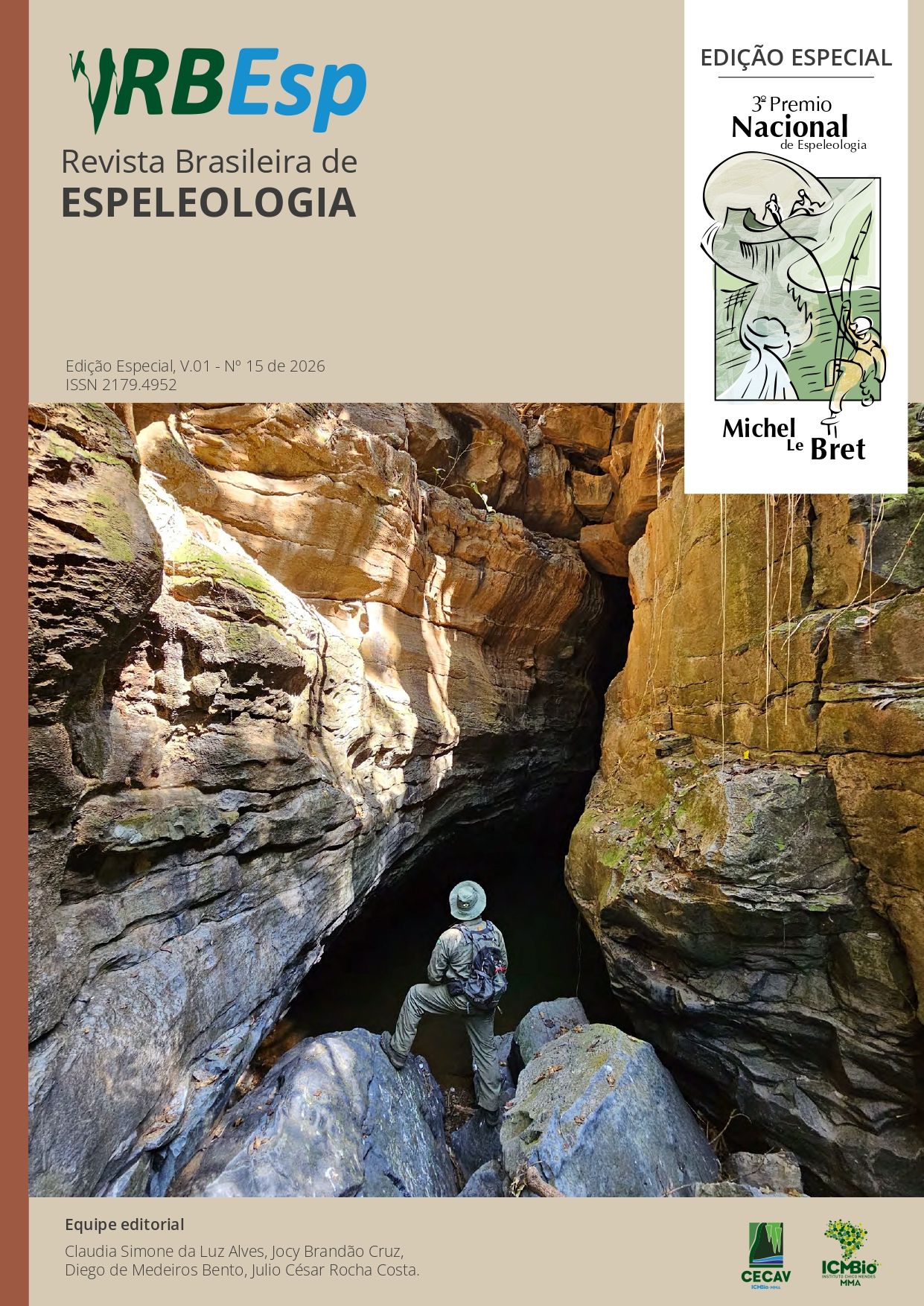
A TREASURE BEYOND IRON ORE: FUNGAL RICHNESS IN NATURAL FERRUGINOUS CAVES IN THE SOUTHERN ESPINHAÇO MOUNTAIN RANGE, MINAS GERAIS
DOI:
https://doi.org/10.37002/rbesp.v1i15.2939Keywords:
Biospeleology, Caves, Cladosporium, mycology, taxonomy, PenicilliumAbstract
Caves, being unique environments with singular characteristics, harbor a high diversity of fungi, including unknown species, with potential for biotechnological use. In recent years, studies on cave fungi have highlighted these environments as a
new frontier for the expansion of knowledge in the field of mycology. In this context, the objective of this study was to investigate cultivable filamentous fungi present in ferruginous caves and in a ferruginous quartzite cave in the region between the municipalities of Serro and Conceição do Mato Dentro, in the Serra do Espinhaço Meridional, in Minas Gerais. Samples of particles present in the air, animal dung, roots, rock, litter, and sediment/soil were collected for the isolation of cave fungi. The collections were carried out in five ferruginous caves in the Serra da Ferrugem and in the ferruginous quartzite cave Curral de Pedras, both in Conceição do Mato Dentro, in addition to a collection in a ferruginous cave in Alvorada de Minas, district of Itapanhoacanga. In total, 887 fungal isolates were obtained from the sampled ferruginous caves, with 274 isolates from soil, 258 from air, 128 from litter, 106 from animal dung, 70 from rocks, and 51 from roots. To identify the isolates, total genomic DNA was extracted, followed by amplification and sequencing of the ITS (Internal Transcribed Spacer) region. The isolates were identified at the genus taxonomic level by comparing the ITS sequences obtained with the megablast tool, using the GenBank database.
Four phyla (Ascomycota, Mucoromycota, Basidiomycota, and Zoopagomycota), 13 classes, 36 orders, 70 families, and 145 genera were found. The phylum Ascomycota was the most predominant, with the genera Penicillium and Cladosporium being the most frequent. This study points out that ferruginous caves in the Southern Espinhaço Mountains harbor a high wealth of fungal genera, highlighting the potential for the discovery of new species.
References
ADETUTU, E. M.; THORPE, K.; BOURNE, S.; CAO, X.; SHAHSAVARI, E.; KIRBY, G.; BALL,
A. S. Phylogenetic diversity of fungal communities in areas accessible and not accessible to tourists in Naracoorte Caves. Mycologia, v. 103, n. 5, p. 959-968, 2011.
ALMEIDA, M. DE A.; ALMEIDA-SILVA, F.; GUIMARÃES, A. J.; ALMEIDA-PAES, R.;
ZANCOPÉ-OLIVEIRA, R. M. The occurrence of histoplasmosis in Brazil: A systematic review.
International Journal of Infectious Diseases, v. 86, p. 147–156, 2019.
ALVES, V. C. S.; LIRA, R. A.; LIMA, J. M. S.; BARBOSA, R. N.; BENTO, D. M.; BARBIER, E.; BERNARD, E.; SOUZA-MOTTA, C. M.; BEZERRA, J. D. P. Unravelling the fungal darkness in a tropical cave: richness and the description of one new genus and six new specie. Fungal Systematics and Evolution, 2022.
BIAGIOLI, F.; COLEINE, C.; DELGADO-BAQUERIZO, M.; FENG, Y.; SAIZ-JIMENEZ, C.;
SELBMANN, L. Outdoor climate drives diversity patterns of dominant microbial taxa in caves worldwide. Science of The Total Environment, v. 906, 167674, 2024.
CARVALHO, J. L. V. R.; LIMA, J. M. S.; BARBIER, E.; BERNARD, E.; BEZERRA, J. D. P.; SOUZA-MOTTA, C. M. Ticket to ride: fungi from bat ectoparasites in a tropical cave and the description of two new species. Braz J Microbiol., 2022.
CASTAÑEDA-RUIZ, R. F.; STADLER, M.; SAIKAWA, M.; ITURRIAGA, T.; DECOCK, C.;
HEREDIA, G. Microfungi from submerged plant material: Zelotriadelphia amoena gen. et sp. nov. and Vanakripa fasciata sp. nov. Mycotaxon, v. 91, p. 339–345, 2005.
CASTRILLÓN, A. L.; MORAES, M. A. P.; FURTADO, M. DO S. S. Isolamento de Microsporum amazonicum do solo do Estado do Amazonas, Brasil. Acta Amaz., v. 6, p. 487–490, 1976.
CONDÉ, T. O.; LEÃO, A. F.; DUTRA, Y. L. G.; ROSADO, A. W. C.; NEVES, S. DE C.; FRAGA, L. M. S.; KASUYA, M. C. M.; PEREIRA, O. L. Shedding light on the darkness: a new genus and four new species in the family Chaetomiaceae from Brazilian neotropical caves revealed by multi-gene phylogenetic analyses. Mycological Progress, v. 22, p. 49, 2023.
CUNHA, A. O. B.; BEZERRA, J. D. P.; OLIVEIRA, T. G. L.; BARBIER, E.; BERNARD, E.; MACHADO, A. R.; SOUZA-MOTTA, C. M. Living in the dark: Bat caves as hotspots of fungal diversity. PLoS ONE, v. 15, e0243494, 2020.
DIAS, M. A. G.; OLIVEIRA, R. M. Z.; GIUDICE, M. C.; NETTO, H. M.; JORDÃO, L. R.; GRIGORIO, I. M.; ROSA, A. R.; AMORIM, J.; NOSANCHUK, J. D.; TRAVASSOS, L. R.; TABORDA, C. P. Isolation of Histoplasma capsulatum from bats in the urban area of São Paulo State, Brazil. Epidemiol. Infect., v.139, p. 1642–1644, 2011.
DIAS, T. H.; MADEIRA FILHO, W. PROJETO MINAS-RIO NO ENTORNO DO MONUMENTO NATURAL SERRA DA FERRUGEM. CES 35, 2020.
DUTRA, Y. L. G.; ROSADO, A. W. C.; CONDÉ, T. O.; LEÃO, A. F.; NEVES, S. D. C.; FRAGA, L. M. S.; KASUYA, M. C. M.; PEREIRA, O. L. Two new Cladosporium species from a quartzite cave in Brazil. Braz J Microbiol, v. 54, p. 3021–3031, 2023.
HAWKSWORTH, D. L.; LÜCKING, R. Fungal Diversity Revisited: 2.2 to 3.8 Million Species.
Microbiol Spectr, v. 5, 5.4.10, 2017.
JOSHI, S. R.; CHETTRI, U. Fungi in Hypogean Environment: Bioprospection Perspective, in: Satyanarayana, T.; Deshmukh, S.K.; Deshpande, M.V. (Eds.), Advancing Frontiers in Mycology & Mycotechnology. Springer Singapore, Singapore, pp. 539–561, 2019.
KOZLOVA, E. V.; MAZINA, S. E. Biodiversity of Fungi in the photic and aphotic zones of Montenegro caves. Aerobiologia, v. 36, p. 589–604, 2020.
KUZMINA, L. Y.; GALIMZIANOVA, N. F.; ABDULLIN, S. R.; RYABOVA, A. S. Microbiota of
the Kinderlinskaya cave (South Urals, Russia). Microbiology, v. 81, p. 251–258, 2012.
LEÃO, A. F.; CONDÉ, T. O.; DUTRA, Y. L. G.; ROSADO, A. W. C.; GRAZZIOTTI, P. H.; DE CARVALHO NEVES, S.; FRAGA, L. M. S.; KASUYA, M. C. M.; PEREIRA, O. L. Amphichorda monjolensis sp. nov.; a new fungal species isolated from a Brazilian limestone cave, with an update on acremonium-like species in Bionectriaceae. Braz J Microbiol, 2024.
LEÃO-FERREIRA, S. M.; PASCHOLATI GUSMÃO, L. F.; CASTAÑEDA RUIZ, R. F.
Conidial fungi from the semi-arid Caatinga biome of Brazil. Three new species and new records.
nova_hedwigia, 96, 479–494, 2013.
MINISTÉRIO DO MEIO AMBIENTE. Anuário estatístico do patrimônio espeleológico brasileiro. Centro Nacional de Pesquisa e Conservação de Cavernas, 2025. Disponível em:
< https://www.gov.br/icmbio/pt-br/assuntos/centros-de-pesquisa/cavernas/anuario-estatistico-do-patrimonio-espeleologico-brasileiro/cecav-anuario-estatistico-espeleologico-2023-24.pdf>. Acesso em: 26 jun. 2025.
NISKANEN, T.; LÜCKING, R.; DAHLBERG, A.; GAYA, E.; SUZ, L. M.; MIKRYUKOV, V.; LIIMATAINEN, K.; DRUZHININA, I.; WESTRIP, J. R. S.; MUELLER, G. M.; MARTINS-CUNHA, K.; KIRK, P.; TEDERSOO, L.; ANTONELLI, A. Pushing the Frontiers of Biodiversity Research: Unveiling the Global Diversity, Distribution, and Conservation of Fungi. Annu. Rev. Environ. Resour., v. 48, p. 149–176, 2023.
NOVÁKOVÁ, A.; KUBÁTOVÁ, A.; SKLENÁŘ, F.; HUBKA, V. Microscopic fungi on cadavers and skeletons from cave and mine environments. Czech Mycol., v. 70, p. 101–121, 2018.
OLIVEIRA, J. A.; CUSTÓDIO, F. A.; PEREIRA, O. L. Cultivable root endophytic fungi associated with Acrocomia aculeata and its antagonistic activity against phytopathogenic oomycetes. Brazilian J Microbiol, 2024.
PEREIRA, M. L. S.; CARVALHO, J. L. V. R.; LIMA, J. M. S.; BARBIER, E.; BERNARD, E.; BEZERRA, J. D. P.; SOUZA-MOTTA, C. M. Richness of Cladosporium in a tropical bat cave with the description of two new species. Mycol Progress, v. 21, p. 345–357, 2022.
PINHO, D. B.; FIRMINO, A. L.; FERREIRA-JUNIOR, W. G.; PEREIRA, O. L. An efficient protocol for DNA extraction from Meliolales and the description of Meliola centellae sp. nov. Mycotaxon, v. 122, p. 333–345, 2013.
ROCHA-SILVA, F.; FIGUEIREDO, S. M.; SILVEIRA, T. T. S.; ASSUNÇÃO, C. B.; CAMPOLINA, S. S.; PENA-BARBOSA, J. P. P.; ROTONDO, A.; CALIGIORNE, R. B. Histoplasmosis outbreak in Tamboril cave—Minas Gerais state, Brazil. Medical Mycology Case Reports, v. 4, p. 1–4, 2014.
SHARMA, L.; SOUSA, M.; FARIA, A.S.; NUNES-PEREIRA, M.; CABRAL, J. A.; PHILLIPS,
A. J. L.; MARQUES, G.; PAIVA-CARDOSO, M. DAS N. Worldwide recombination in emergent white-nose syndrome pathogen Pseudogymnoascus destructans (preprint). Ecology, 2019.
SILVA, F. R.; FIGUEIREDO, S. M.; SILVEIRA, T. T. S.; ASSUNÇÃO, C. B.; CAMPOLINA, S. S.; PENA-BARBOSA, J. P. P.; ROTONDO, A.; CALIGIORNE, R. B. Histoplasmosis outbreak in Tamboril cave – Minas Gerais state, Brazil. Medical Mycology Case Reports, v. 4, p. 1–4, 2014.
TAYLOR, E.; RESENDE STOIANOFF, M.; LOPES FERREIRA, R. Mycological study for a
management plan of a neotropical show cave (Brazil). IJS, v. 42, p. 267–277, 2013.
TAYLOR, E. L. S.; FERREIRA, R. L.; CARDOSO, P. G.; STOIANOFF, M. A. D. R. Cave Entrance dependent Spore Dispersion of Filamentous Fungi Isolated from Various Sediments of Iron Ore Cave in Brazil: a colloquy on human threats whilecaving. AMBIENT SCIENCE, v. 1, p. 16–28, 2014.
TEDERSOO, L.; BAHRAM, M.; PÕLME, S.; KÕLJALG, U.; YOROU, N. S.; WIJESUNDERA, R.; RUIZ, L. V.; VASCO-PALACIOS, A. M.; THU, P. Q.; SUIJA, A.; SMITH, M. E.; SHARP, C.; SALUVEER, E.; SAITTA, A.; ROSAS, M.; RIIT, T.; RATKOWSKY, D.; PRITSCH, K.; PÕLDMAA, K.; PIEPENBRING, M.; PHOSRI, C.; PETERSON, M.; PARTS, K.; PÄRTEL, K.; OTSING, E.; NOUHRA, E.; NJOUONKOU, A. L.; NILSSON, R. H.; MORGADO, L. N.; MAYOR, J.; MAY, T. W.; MAJUAKIM, L.; LODGE, D. J.; LEE, S. S.; LARSSON, K.-H.; KOHOUT, P.; HOSAKA, K.; HIIESALU, I.; HENKEL, T. W.; HAREND, H.; GUO, L.; GRESLEBIN, A.; GRELET, G.; GEML, J.; GATES, G.; DUNSTAN, W.; DUNK, C.; DRENKHAN, R.; DEARNALEY, J.; DE KESEL, A.; DANG, T.; CHEN, X.; BUEGGER, F.; BREARLEY, F. Q.; BONITO, G.; ANSLAN, S.; ABELL, S.; ABARENKOV, K. Global diversity and geography of soil fungi. Science, v. 346, 1256688, 2014.
TUITE, J. Plant pathological methods. Fungi and bacteria. Burgess Publishing Company, 1969. VANDERWOLF, K.; MALLOCH, D.; MCALPINE, D.; FORBES, G. A world review of fungi,
yeasts, and slime molds in caves. IJS, v. 42, p. 77–96, 2013.
VILGALYS, R.; HESTER, M. Rapid genetic identification and mapping of enzymatically amplified ribosomal DNA from several Cryptococcus species. J Bacteriol, v. 172, p. 4238–4246, 1990.
WHITE, T.J.; BRUNS, T.; LEE, S.; TAYLOR, J. Amplification and direct sequencing of fungal ribosomal RNA genes for phylogenetics. PCR protocols: a guide to methods and applications, v. 18,
p. 315–322, 1990.
WISESCHART, A.; POOTANAKIT, K. Metagenomic-based approach to a comprehensive understanding of cave microbial diversity, in: De Mandal, S.; Bhatt, P. (Eds.), Recent Advancements in Microbial Diversity. Academic Press, p. 561–586, 2020.
ZHANG, Z. F.; LIU, F.; ZHOU, X.; LIU, X. Z.; LIU, S. J.; CAI, L. Culturable mycobiota from Karst caves in China, with descriptions of 20 new species. Persoonia, v. 39, p. 1–31, 2017.
ZHANG, Z. -F.; ZHOU, S. -Y.; EURWILAICHITR, L.; INGSRISWANG, S.; RAZA, M.; CHEN, Q.;
ZHAO, P.; LIU, F.; CAI, L. Culturable mycobiota from Karst caves in China II, with descriptions of 33 new species. Fungal Diversity, v. 106, p. 29–136, 2021.