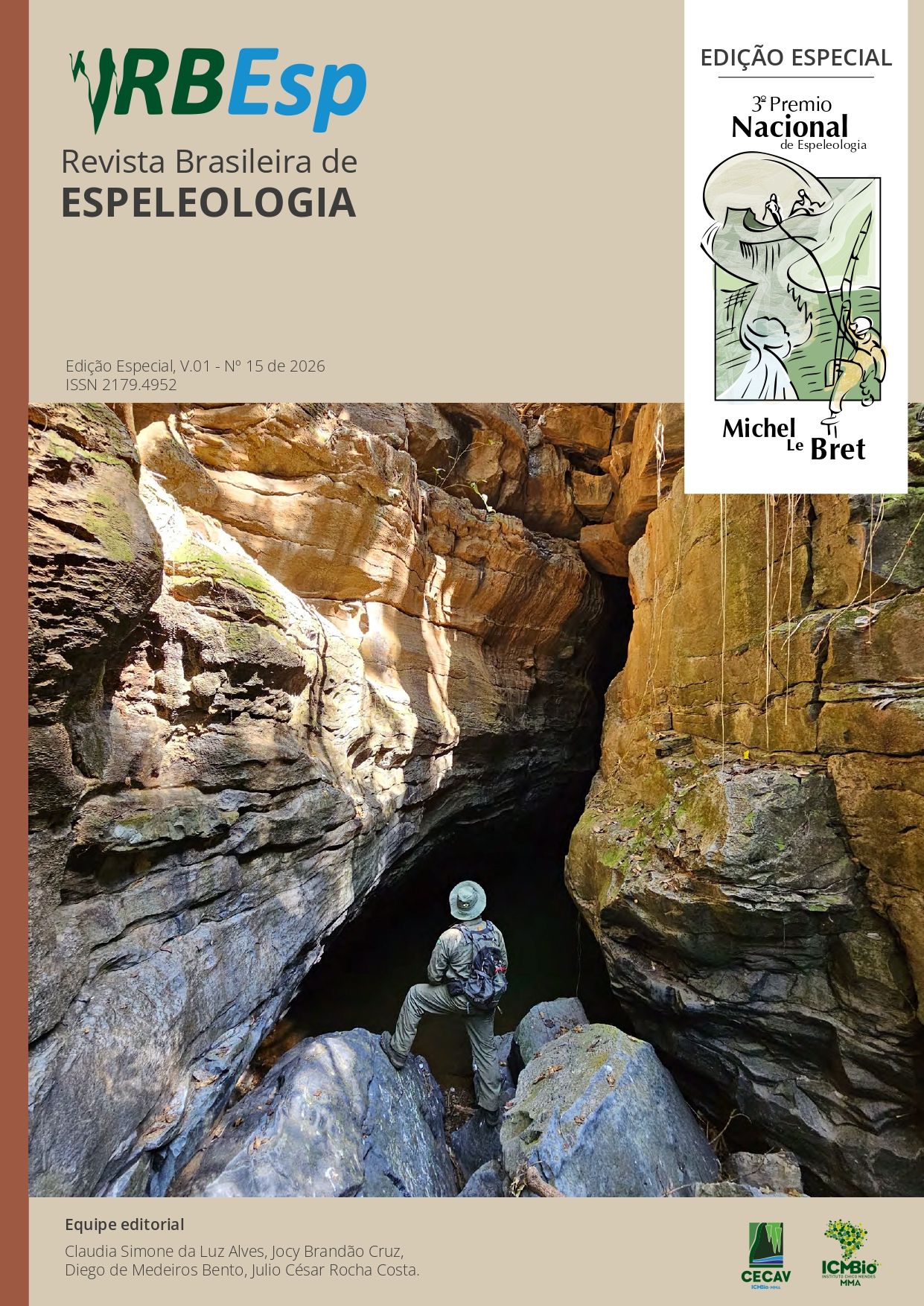
PRIORIZAÇÃO ESPACIAL PARA CONSERVAÇÃO DAS ÁREAS CÁRSTICAS BRASILEIRAS
DOI:
https://doi.org/10.37002/rbesp.v1i15.2943Palabras clave:
patrimônio espeleológico, espeleologia, impacto antrópico, priorização espacial, conservaçãoResumen
As áreas cársticas brasileiras são regiões de alto valor biológico, geológico e humano que exercem provisão de serviços ecossistêmicos, como os aquíferos e os minerais. Apesar da existência de leis ambientais, as áreas cársticas ainda são pouco estudadas e pouco protegidas no Brasil. Este trabalho propõe uma priorização espacial para conservação destas áreas com base em indicadores de impacto antrópico, da rede de unidades de conservação e da cobertura de vegetação natural. Os resultados demonstram que grande parte das regiões cársticas brasileiras estão sob forte impacto antrópico, com baixa cobertura de vegetação natural e pouco protegidas pela legislação. Destacamos a necessidade de inclusão de “manchas” cársticas em políticas públicas, principalmente na criação unidades de conservação, além de reforçar que o uso sustentável dos recursos nessas regiões, mesmo que altamente exploradas, é a única solução viável para garantir a continuidade de atividades econômicas, a existência de ecossistemas saudáveis e a manutenção dos serviços ecossistêmicos.
Citas
BELANDI, C. Between 2000 and 2020, agricultural area grew 230 thousand km², natural vegetation reduced 513 thousand km² in Brazil. IBGE. 2022. disponível em: https://agenciadenoticias.ibge.gov.br/en/agencia-news/2184-news-agency/news/35174-between-2000-and-2020-agricultural-area-grew-230-thousand-km-natural-vegetation-reduced-513-thousand-km-in-brazil. Acesso em: 12 dez. 2024.
BRASIL. Decreto no 99.556, de 1 de outubro de 1990. Dispõe sobre a proteção das cavidades naturais subterrâneas existentes no território nacional, e dá outras providências. Diário Oficial [da] República Federativa do Brasil, Brasília, DF, p. 18836. 2 out. 1990.
BRASIL. Lei nº 9.985, de 18 de julho de 2000. Regulamenta o art. 225, § 1o, incisos I, II, III e VII da Constituição Federal, institui o Sistema Nacional de Unidades de Conservação da Natureza e dá outras providências. Diário Oficial [da] República Federativa do Brasil, Brasília, DF, p. 1. 19 jul. 2000.
BRASIL. Decreto nº 6.640, de 7 de novembro de 2008. Dá nova redação aos arts. 1o, 2o, 3o, 4o e 5o e acrescenta os arts. 5-A e 5-B ao Decreto no 99.556, de 1o de outubro de 1990, que dispõe sobre a proteção das cavidades naturais subterrâneas existentes no território nacional. Diário Oficial [da] República Federativa do Brasil, Brasília, DF, p. 8. 10 nov. 2008.
BRASIL. Ministério do Meio Ambiente. Instrução Normativa nº 02, de 20 de agosto de 2009. Institui a metodologia de classificação do grau de relevância de cavidades naturais subterrâneas. Diário Oficial [da] República Federativa do Brasil, Brasília, n. 160, p. 68-69, 21 ago. 2009.
BRASIL. Decreto nº 10.935, de 12 de janeiro de 2022. Dispõe sobre a proteção das cavidades naturais subterrâneas existentes no território nacional. Diário Oficial [da] República Federativa do Brasil, Brasília, DF, 12 de janeiro de 2022.
CAPOANE, V.; FUSHIMI, M. Devastation of the cerrado of mato grosso do sul and the advance of arenization in the pardo river watershed. Discover Environment, v.2, n. 1, p.111, 2024.
CARVALHO, J. L. N.; AVANZI, J. C.; SILVA, M. L. N.; MELLO, C. R. D.; CERRI, C. E. P. (2010). Potencial de sequestro de carbono em diferentes biomas do Brasil. Revista Brasileira de Ciência do Solo, v. 34, p. 277-290, 2010.
CEBALLOS, G.; EHRLICH, P. R.; BARNOSKY, A. D.; GARCÍA, A.; PRINGLE, R. M.; PALMER, T. M. Accelerated modern human–induced species losses: Entering the sixth mass extinction. Science advances, v. 1, n. 5, 2015.
CERKVENIK, R. Impacts of visitors on cave's physical environment. Pesquisas em Turismo e Paisagens Cársticas. v. 9, n. 1, 2016.
CHEN, J.; XIAO, H.; LI, Z.; LIU, C.; WANG, D.; WANG, L.; TANG, C. (2019). Threshold effects of vegetation coverage on soil erosion control in small watersheds of the red soil hilly region in China. Ecological Engineering, v. 132, p. 109–114, 2019.
COSTA, D. P.; LENTINI, C. A.; CUNHA LIMA, A. T.; DUVERGER, S. G.; VASCONCELOS, R. N.; HERRMANN, S. M.; FERREIRA-FERREIRA, J.; OLIVEIRA, M.; DA SILVA BARBOSA, L.; CORDEIRO, C. L.; SANTOS, N. A. All Deforestation Matters: Deforestation Alert System for the Caatinga Biome in South America’s Tropical Dry Forest. Sustainability, v. 16, n. 20, p. 9006, 2024.
DEAN, W. A Ferro e fogo: a história e a devastação da Mata Atlântica brasileira. São Paulo: Companhia das Letras, 1996. 484p.
DIRZO, R.; YOUNG, H. S.; GALETTI, M.; CEBALLOS, G.; ISAAC, N. J.; COLLEN, B. Defaunation in the Anthropocene. Science, v. 345, n. 6195, p. 401-406, 2014.
DONATO, C. R.; Oliveira, A. G.; MACEDO, H. S.; DONATO, R. R.; SILVA, M. R. Protegendo as cavernas do Brasil. Brasília: ICMBio, 2018.
ELLIS, E. C.; RAMANKUTTY, N. Putting people in the map: anthropogenic biomes of the world. Frontiers in Ecology and the Environment, v. 6, n. 8, p. 439-447, 2008.
FATTORINI, S.; FIASCA, B.; DI LORENZO, T.; DI CICCO, M.; GALASSI, D. M. A new protocol for assessing the conservation priority of groundwater‐dependent ecosystems. Aquatic Conservation: Marine and Freshwater Ecosystems, v. 30, n. 8, p. 1483-1504, 2020.
FORD D. C.; WILLIAMS P. W. Karst Hydrogeology and Geomorphology. John Wiley & Sons, Chichester: 2007. 562p.
GUTIÉRREZ, J. A.; DUIVENVOORDEN. J. F. Can we expect to protect threatened species in protected areas? A case study of the genus Pinus in Mexico. Revista mexicana de biodiversidad, v. 81, n. 3, p. 875-882, 2010.
ICMBioa. Áreas de ocorrência de cavernas no Brasil. Disponível em: https://www.gov.br/icmbio/pt-br/assuntos/centros-de-pesquisa/cavernas/publicacoes/Area%20de%20Ocorrencia%20de%20Cavernas). Acesso em: 27 nov. 2024.
ICMBiob. Plano de ação nacional para conservação do patrimônio espeleológico brasileiro.
2024. Disponível em: https://www.gov.br/icmbio/pt-br/assuntos/biodiversidade/pan/pan-cavernas-do-brasil. Acesso em: 11 dez. 2024.
IUCN. IUCN WCPA Caves and Karst Working Group. 2024. Disponível em: https://iucn.org/our-union/commissions/group/iucn-wcpa-geoheritage-specialist-group/iucn-wcpa-caves-and-karst. Acesso em: 12 dez. 2024.
JAUREGUIBERRY, P.; TITEUX, N.; WIEMERS, M.; BOWLER, D. E.; COSCIEME, L.; GOLDEN, A.S.; GUERRA, C. A.; JACOB, U.; TAKAHASHI, Y.; SETTELE, J.; DÍAZ, S. The direct drivers of recent global anthropogenic biodiversity loss. Science advances, v. 8, n. 45, 2022.
KONZEN, I. S. GAMBOA, A.; GAIDA, W.; ROSA, G. M.; FLACH, K. A.; BONES, U. A.; BREUNIG, F. N.; MENDONÇA, A. M.; MAHNKE, M. R.; MACIEL, D. H. Impact of anthropogenic activities and land use on water quality: an analysis in microbasins in Rio Grande Do Sul, Brazil. Hygeia, v. 20, 2024.
LAMOUNIER, W. L.; DOS SANTOS, J. S.; RODRIGUES, E. L.; DRUMOND, M. A. Defining priority areas for conservation based on multispecies functional connectivity. Biological Conservation, v. 290, 2024.
LA SALVIA, E. S.; SIMÕES, P. R. G. A área cárstica do Alto Vale do Rio Piauí, São Raymundo Nonato e Coronel José Dias/pi: uma visão preliminar. In: Congresso Brasileiro de Espeleologia. 24., 1997, Ouro Preto. Anais… Ouro Preto: SEB, 1997, Campinas: SBE, p.109-112, 2017.
LI, X.; ZHANG, Y.; MA, N.; ZHANG, X.; TIAN, J.; ZHANG, L.; MCVICAR, T. R.; WANG, E.; XU, J. Increased grain crop production intensifies the water crisis in Northern China. Earth's Future, v. 11, n. 9, 2023.
LIMA, S. M. S. A.; LOPES, W. G. R.; FAÇANHA, A. C. Alterações na cobertura do solo em Teresina, Piauí, Brasil. Sociedade e Natureza, v. 33, p. e58922, 2021.
LOCKE, K. A.; WINTER, K. Estimating thresholds of natural vegetation for the protection of water quality in south African catchments. Science of The Total Environment, p.173924, 2024.
MAMMOLA, S.; LEROY, B. Applying species distribution models to caves and other subterranean habitats. Ecography, v. 41, n. 7, p. 1194-1208, 2018.
MAPBIOMAS. MapBiomas launches unprecedented platform that for the first time assesses degradation in all Brazilian biomes. 2024. Disponível em: https://brasil.mapbiomas.org/en/2024/07/05/ate-25-da-vegetacao-nativa-do-brasil-pode-estar-degradada/. Acesso em: 10 dez. 2024.
MARQUES, L. Brazil, 200 years of devastation: What will remain of the country after 2022? Estudos Avançados, v. 36, p. 169-184, 2022.
MILLENNIUM ECOSYSTEM ASSESSMENT. Ecosystems and Human Well-being: Synthesis. Washington, DC: Island Press, 2005.
MU, H.; LI, X.; WEN, Y.; HUANG, J.; DU, P.; SU, W.; MIAO, S.; GENG, M. A global record of annual terrestrial Human Footprint dataset from 2000 to 2018. Scientific Data, v. 9, n. 1, p.176, 2022.
NITZU, E.; VLAICU, M.; GIURGINCA, A.; MELEG, I. N.; POPA, I.; NAE, A.; BABA, Ş. Assessing preservation priorities of caves and karst areas using the frequency of endemic cave-dwelling species. International Journal of Speleology, v. 47, n. 1, p. 43-52, 2018.
OLIVEIRA, U.; SOARES-FILHO, B. S.; PAGLIA, A. P.; BRESCOVIT, A. D.; DE CARVALHO, C. J.; SILVA, D. P.; REZENDE, D. T.; LEITE, F. S. F.; BATISTA, J. A. N.; BARBOSA, J. P. P. P.; STEHMANN, J. R. Biodiversity conservation gaps in the Brazilian protected areas. Scientific reports, v. 7. n. 1, p. 9141, 2017.
OLIVEIRA, M. P.; FERREIRA, R. L. Extending beyond individual caves: a graph theory approach broadening conservation priorities in Amazon iron ore caves. PeerJ, v. 12, p. e16877, 2024.
PAMARDHI-UTOMO, R. A strategy for the sustainable development of the karst area in Wonogiri. In: IOP Conference Series: Earth and Environmental Science, v. 447, n. 1. IOP Publishing, 2020.
PERET, E. IBGE releases Changes in Land Use and Cover by state between 2000 and 2018. IBGE. 2021. Disponível em: https://agenciadenoticias.ibge.gov.br/en/agencia-news/2184-news-agency/news/30325-ibge-releases-changes-in-land-use-and-cover-by-state-between-2000-and-2018. Acesso em: 21 dez. 2024.
PRASNIEWSKI, V. M.; GONZALEZ-DAZA, W.; ALVARENGA, G. D. V.; SANTOS-SILVA, L.; TEIXIDO, A. L.; IZZO, T. J. Economic, environmental and social threats of a mining exploration proposal on indigenous lands of Brazil. Acta Amazonica, v. 54, n. 2, 2024.
PIMM, S. L.; JENKINS, C. N.; LI, B. V. How to protect half of Earth to ensure it protects sufficient biodiversity. Science advances, v. 4, n. 8, 2018.
QI, X.; ZHANG, C.; WANG, K. Comparing remote sensing methods for monitoring karst rocky desertification at sub-pixel scales in a highly heterogeneous karst region. Scientific reports, v. 9, n. 1, p. 13368, 2019.
RABELO, L. M.; SOUZA-SILVA, M.; FERREIRA, R. L. Priority caves for biodiversity conservation in a key karst area of Brazil: comparing the applicability of cave conservation indices. Biodivers Conserv , v. 27, p. 2097–2129, 2018.
RIBEIRO, D.; ZORN, M. Sustainability and Slovenian karst landscapes: Evaluation of a low karst plain. Sustainability, v. 13, n. 4, p. 1655, 2021.
RIBEIRO, S.; MOREIRA, L. F.; OVERBECK, G. E.; MALTCHIK, L. Protected Areas of the Pampa biome presented land use incompatible with conservation purposes. Journal of Land Use Science, v. 16, n. 3, p. 260-272, 2021.
ROE, D, S. N.; ELLIOTT, J. Biodiversity loss is a development issue: a rapid review of evidence. London: IIED Issue Paper. IIED, 2019.
SANDERSON, E. W.; JAITEH, M.; LEVY, M. A.; REDFORD, K. H.; WANNEBO, A. V.; WOOLMER, G. The human footprint and the last of the wild: the human footprint is a global map of human influence on the land surface, which suggests that human beings are stewards of nature, whether we like it or not. BioScience, v. 52, n. 10, p. 891-904, 2002.
SIMÕES, M. H.; SOUZA-SILVA, M.; FERREIRA, R. L. Cave invertebrates in Northwestern Minas Gerais state, Brazil: endemism, threats and conservation priorities. Acta Carsologica, v. 43, p. 159–174, 2014.
SINIMBÚ, F. Brazil has lost 33% of its natural areas 1985–2023. Agência Brasil. 2024. Disponível em: https://agenciabrasil.ebc.com.br/en/geral/noticia/2024-08/brazil-has-lost-33-its-natural-areas-1985-2023. Acesso em: 12 dez. 2024.
SOARES-FILHO, B. S.; OLIVEIRA, U.; FERREIRA, M. N.; MARQUES, F. F. C.; DE OLIVEIRA, A. R.; SILVA, F. R.; BÖRNER, J. Contribution of the Amazon protected areas program to forest conservation. Biological Conservation, v. 279, p. 109928, 2023.
SODHI, N. S.; EHRLICH, P. R. Conservation biology for all. Oxford: Oxford university press, 2010.
SONTER, L. J.; HERRERA, D.; BARRETT, D. J.; GALFORD, G. L.; MORAN, C. J.; SOARES-FILHO, B. S. Mining drives extensive deforestation in the Brazilian Amazon. Nature communications, v. 8, n. 1, p. 1013, 2017.
SOUZA-SILVA, M.; MARTINS R. P.; FERREIRA, R. L. Cave conservation priority index to adopt a rapid protection strategy: a case study in Brazilian Atlantic Rain Forest. Environ Manage, v. 55, p. 279–295, 2015.
SOUZA, M. F. V. R.; ALVARENGA, D. A.; SOUZA-SILVA, M.; FERREIRA, R. L. Do different relevance attributes indicate the same conservation priorities? A case study in caves of southeastern Brazil. International Journal of Speleology, v. 50, n. 3, p. 223-238, 2021.
STANKOVIĆ, M. V. Biodiversity in Karst Landscapes: Introduction to the Special Issue. Diversity, v. 15, n. 3, p. 408, 2023.
UN. Sustainable Development Goals: 15 Life and Land. 2023. Disponível em: https://www.un.org/sustainabledevelopment/biodiversity/. Acesso em: 15 dez. 2024.
SOBRAL-SOUZA, T.; VANCINE, M. H.; RIBEIRO, M. C.; LIMA-RIBEIRO, M. S.; Efficiency of protected areas in Amazon and Atlantic Forest conservation: A spatio-temporal view. Acta Oecologica, v. 87, p. 1-7, 2018.
THEULEN, V.; SESSEGOLO, G. C. Estratégias para conservação das cavernas brasileiras. SPELEO BRAZIL, v. 2001, p. 268-271, 2001.
UNDP. Transforming our world: the 2030 Agenda for Sustainable Development. 2018. Disponível em:
https://www.undp.org/ukraine/publications/transforming-our-world-2030-agenda-sustainable-development. Acesso em: 15 dez. 2024.
UNEP. Leaders’ pledge for nature: United to reverse biodiversity loss by 2030 for sustainable development. 2020. Disponível em: www.leaderspledgefornature.org. Acesso em: 26 nov. 2024.
VENTER, O.; SANDERSON, E. W.; MAGRACH, A.; ALLAN, J. R.; BEHER, J.; JONES, K. R.; POSSINGHAM, H. P.; LAURANCE, W. F.; WOOD, P.; FEKETE, B. M.; LEVY, M. A. Global terrestrial Human Footprint maps for 1993 and 2009. Scientific data, v. 3, n. 1, p. 1-10, 2016.
VIEIRA, R. R.; PRESSEY, R. L.; LOYOLA, R. The residual nature of protected areas in Brazil. Biological Conservation, v. 233, p. 152-161, 2019.
WILSON, M. C.; CHEN, X. Y.; CORLETT, R. T.; DIDHAM, R. K.; DING, P.; HOLT, R. D.; HOLYOAK, M.; HU, G.; HUGHES, A. C.; JIANG, L.; LAURANCE, W. F. Habitat fragmentation and biodiversity conservation: key findings and future challenges. Landscape Ecology, v. 31, p.219-227, 2016.
WWF. Deforestation in the Amazon remains at high levels, with a rate of 11,568 km² in 2022. 2022. Disponível em: https://www.wwf.org.br/?84261/Deforestation-in-the-Amazon-remains-at-high-levels-with-a-rate-of-11568-km2-in-2022. Acesso em: 20 dez. 2024.
ZALASIEWICZ, J.; ADENEY THOMAS, J.; WATERS, C. N.; TURNER, S.; HEAD, M. J. The meaning of the Anthropocene: why it matters even without a formal geological definition. Nature, v. 632, n. 8027, p. 980-984, 2024.