
Baseline corticosterone levels of a migratory bird in brazilian cerrado
DOI:
https://doi.org/10.37002/biodiversidadebrasileira.v15i2.2752Palavras-chave:
Bird hormones , stress levels, neotropical savannaResumo
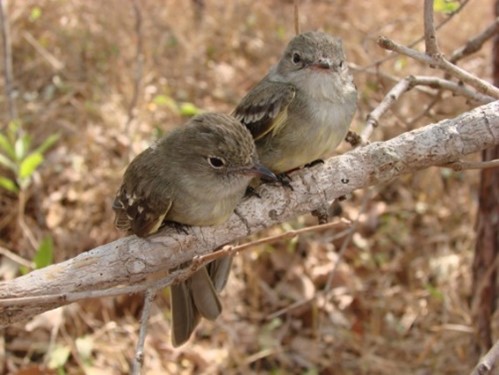
The main physiological parameter used in birds stress analyses is the corticosterone level. That hormone has been the main tool used to infer physiological state, but little is known about those levels in the tropical birds. Lesser Elaenia, Elaenia chiriquensis albivertex, is a migratory flycatcher at the cerrado and this study aimed to measure baseline corticosterone levels during the reproductive phase. The release of baseline corticosterone of Lesser Elaenia was 12.96 ± 5,07 ng/mL (n = 43). There was a positive correlation between corticosterone and body mass (y = 4.2329x - 54.844; R² = 0.7839). Our study shows a important record of basal corticosterone of a tropical bird during migration with a potential to evaluate individuals health such as in animal rehabilitation and release programs.
Downloads
Referências
Angelier F, Tonra CM, Holberton RL, Marra PP. How to capture wild passerine species to study baseline corticosterone levels. J. Ornithol. 2010; 151:415-422. DOI: https://doi.org/10.1007/s10336-009-0471-6
https://doi.org/10.1007/s10336-009-0471-6 DOI: https://doi.org/10.1007/s10336-009-0471-6
Bókony V, Lendvai AZ, Liker A, Angelier F, Wingfield JC, Chastel O. Stress response and the value of reproduction: are birds prudent parents? Am. Nat. 2009; 173:589-598. https://doi.org/10.1086/597610 DOI: https://doi.org/10.1086/597610
Borges FJA, Marini MÂ. Birds nesting survival in disturbed and protected Neotropical savannas. Biodiv. Conserv. 2010; 19:223-236. https://doi.org/10.1007/s10531-009-9718-z DOI: https://doi.org/10.1007/s10531-009-9718-z
Breuner CW. 2011. Stress and reproduction in birds. In: Norris DO, Lopez KH (eds) Hormones and reproduction of vertebrates Volume 4-Birds. Academic Press; 2005, P. 129-151. DOI: https://doi.org/10.1016/B978-0-12-374929-1.10005-8
Breuner CW, Berk SA. Using the van Noordwijk and de Jong resource framework to evaluate glucocorticoid-fitness hypotheses. Integrat. Comp. Biol. 2019; 59:243-250. https://doi.org/10.1093/icb/icz088 DOI: https://doi.org/10.1093/icb/icz088
Cubas ZS, Silva JCR, Catão-Dias JL. Tratado de animais selvagens, Medicina Veterinária. Editora Roca, São Paulo; 2007.
Deviche P, Sweazea K, Angelier F. Past and future: urbanization and the avian endocrine system. Gen. Comp. Endocrinol. 2023; 332:114159. https://doi.org/10.1016/j.ygcen.2022.114159 DOI: https://doi.org/10.1016/j.ygcen.2022.114159
Evans, HE, Heiser JB. What’s inside: anatomy and physiology. In: Podulka S, et al., editors. Handbook of bird biology. Princeton University Press; 2004. P. 1-161.
Gottsberger G, Silberbauer-Gottsberger I. Life in the Cerrado: A South American Tropical Seasonal Vegetation. Vol. 1: Origin, Structure, Dynamics and Plant Use. Reta: Verlag Ulm; 2006.
Guaraldo AC, Kelly JF, Marini MÂ. Independent trophic behavior and breeding success of a resident flycatcher and a coexisting migratory congener. Austral Ecol. 2019; 44:126-137. https://doi.org/10.1111/aec.12660 DOI: https://doi.org/10.1111/aec.12660
Hau M, Casagrande S, Ouyang JQ, Baugh AT. Chapter Two – Glucocorticoid-mediated phenotypes in vertebrates: multilevel variation and evolution. Adv. Stud. Behav. 2016; 48:41-115. https://doi.org/10.1016/bs.asb.2016.01.002 DOI: https://doi.org/10.1016/bs.asb.2016.01.002
Hau M, Ricklefs RE, Wikelski M, Lee KA, Brawn JD. Corticosterone, testosterone and life-history strategies of birds. Proc. R. Soc. B. 2010; 277:3203-3212. https://doi.org/10.1098/rspb.2010.0673 DOI: https://doi.org/10.1098/rspb.2010.0673
Henderson LJ, Evans NP, Heidinger BJ, Herborn KA, Arnold KE. Do glucocorticoids predict fitness? Linking environmental conditions, corticosterone and reproductive success in the blue tit, Cyanistes caeruleus. Royal Soc. B.-Biol. Sc. 2017; 4:170875-170886. https://doi.org/10.1098/rsos.170875 DOI: https://doi.org/10.1098/rsos.170875
Hill RW, Wyse GA, Anderson M. Animal Physiology. Sinauer Associates Inc, Sunderland; 2008.
Jones BC, Nguyen LT, DuVal EH. Testing the developmental hypothesis of the HPA axis in a tropical passerine: Dampened corticosterone response and faster negative feedback in nestling lance-tailed manakins (Chiroxiphia lanceolata). Gen. Comp. Endocrinol. 2021; 300:113639. https://doi.org/10.1016/j.ygcen.2020.113639 DOI: https://doi.org/10.1016/j.ygcen.2020.113639
Lancaster LT, L. Hazard C, Clobert J, Sinervo BR. Corticosterone manipulation reveals differences in hierarchical organization of multidimensional reproductive trade-offs in r-strategist and K-strategist females. J. Evol. Biol. 2008; 21:556-565. https://doi.org/10.1111/j.1420-9101.2007.01478.x DOI: https://doi.org/10.1111/j.1420-9101.2007.01478.x
Machado-Filho RAN, Balsamão GM, Marini MÂ. Seasonal differences in immune profiles and body conditions of migratory and permanent resident Neotropical flycatchers. Condor. 2010; 112:579-590. https://doi.org/10.1525/cond.2010.090146 DOI: https://doi.org/10.1525/cond.2010.090146
Maness TJ, Grace JK, Hirchak MR, Tompkins EM, Anderson DJ. Circulating corticosterone predicts near-term, white H/L ratio predicts long-term, survival in a long-lived seabird. Front. Ecol. Evol. 2013; 11:1172904. https://doi.org/10.3389/fevo.2023.1172904 DOI: https://doi.org/10.3389/fevo.2023.1172904
Marinho-Filho J, Rodrigues F, Guimarães M. Vertebrados da Estação Ecológica de Águas Emendadas, história natural e ecologia em um fragmento de cerrado do Brasil Central. SEMATEC, IEMA, IBAMA, Brasília; 1998.
Marini MÂ, Borges FJA, Lopes LE, Sousa NOM, Gressler DT, Santos LR, Paiva LV, Duca C, Manica LT, Rodrigues SS, França LF, Costa PM, França LC, Heming NM, Silveira MB, Pereira ZP, Lobo Y, Medeiros RCS, Roper JJ. Breeding biology of birds in the Cerrado of central Brazil. Ornitol. Neotrop. 2012 [cidado 2024 out 06]; 23:385-405. Disponível em: https://sora.unm.edu/sites/default/files/ON%2023%283%29%20385-405.pdf
Marini MÂ, Cavalcanti RB. Migrações de Elaenia albiceps chilensis e Elaenia chiriquensis albivertex (Aves: Tyrannidae). Bol. Mus. Para. Emílio Goeldi, Série Zool. 1990 [citado 2024 out 06]; 6:59-67. Disponível em: https://www.researchgate.net/profile/Miguel-Marini/publication/258999871_Migracoes_de_Elaenia_albiceps_chilensis_e_Elaenia_chiriquensis_albivertex_Aves_Tyrannidae/links/55549b5608ae6fd2d8208c6e/Migracoes-de-Elaenia-albiceps-chilensis-e-Elaenia-chiriquensis-albivertex-Aves-Tyrannidae.pdf
Medeiros RCS, Marini MÂ. Biologia reprodutiva de Elaenia chiriquensis (Lawrence) (Aves, Tyrannidae) em Cerrado do Brasil Central. Rev. Bras. Zool. 2007; 24:12-20 https://doi.org/10.1590/S0101-81752007000100002 DOI: https://doi.org/10.1590/S0101-81752007000100002
Paterlini CA, García GO, Riechert J, Becker PH. Concentrations of hormones during the mid-incubation period in kleptoparasitic and honest Common Terns Sterna hirundo. Acta Ornithol. 2017; 52: 157–165. https://doi.org/10.3161/00016454AO2017.52.2.004 DOI: https://doi.org/10.3161/00016454AO2017.52.2.004
Pereira ZP, Marini MÂ. An intratropical migratory passerine can quickly improve its physiological condition during post migration, reproduction and departure phases on the breeding site in the Cerrado. Rev. Bras. Ornitol. 2015 [citado 2024 out 06]; 23:85-93. Disponível: http://www.revbrasilornitol.com.br/BJO/article/view/1142/pdf_935 DOI: https://doi.org/10.1007/BF03544319
Ricklefs RE, Wikelski M. The physiology/life history nexus. Trends Ecol. Evol. 2002; 17:462-468. https://doi.org/10.1016/S0169-5347(02)02578-8 DOI: https://doi.org/10.1016/S0169-5347(02)02578-8
Ricklefs RE. Density dependence, evolutionary optimization, and the diversification of avian life histories. Condor. 2000; 102:9-22. https://doi.org/10.1650/0010-5422(2000)102[0009:DDEOAT]2.0.CO;2 DOI: https://doi.org/10.1093/condor/102.1.9
Ridgely RS, Tudor G. The birds of South America, The suboscine passerines. University of Texas Press; 1994.
Romero LM. Physiological stress in ecology: lessons from biomedical research. Trends Ecol. Evol. 2004; 19:249-255. https://doi.org/10.1016/j.tree.2004.03.008 DOI: https://doi.org/10.1016/j.tree.2004.03.008
Scheuerlein A, Van’t Hof TJ e Gwinner E. Predators as stressors? Physiology and reproductive consequences of predation risk in tropical stonechats (Saxiola torquata axillaris). Proc. R. Soc. Lond. B. 2001; 268:1575-1582. https://doi.org/10.1098/rspb.2001.1691 DOI: https://doi.org/10.1098/rspb.2001.1691
Schoenle LA, Zimmer C, Vitousek MN. Understanding context dependence in glucocorticoid-fitness relationships: the role of the nature of the challenge, the intensity and frequency of stressors, and life history. Integr. Comp. Biol. 2018; 58:777-789. https://doi.org/10.1093/icb/icy046 DOI: https://doi.org/10.1093/icb/icy046
Silva CA. Precipitações no Cerrado: Análise da variabilidade pluviométrica e influência do fenômeno El Niño Oscilação Sul. PhD. Thesis, Universidade de Brasília, Brazil; 2018. 272 f.
Thrall MA. Veterinary hematology and clinical chemistry. Lippincott Williams and Wilkins, Philadelphia; 2004.
Wikelski M, Cooke S. 2006. Conservation physiology. Trends Ecol. Evol. 21:38-46. https://doi.org/10.1016/j.tree.2005.10.018 DOI: https://doi.org/10.1016/j.tree.2005.10.018
Publicado
Edição
Seção
Licença
Copyright (c) 2025 Zélia da Paz Pereira

Este trabalho está licenciado sob uma licença Creative Commons Attribution-NonCommercial-NoDerivatives 4.0 International License.
Os autores retêm os direitos autorais dos trabalhos publicados, que podem ser reutilizados e divulgados em outros meios, desde que a fonte de publicação original (revista Biodiversidade Brasileira) seja citada.