Market-based Options for Supporting Sustainable Fire Management of Fire-prone Cerrado (Savanna) Remnant Landscapes
DOI:
https://doi.org/10.37002/biobrasil.v11i2.1725Keywords:
Fire regimes, wildfires, prescribed burning, indigenous fire managementAbstract
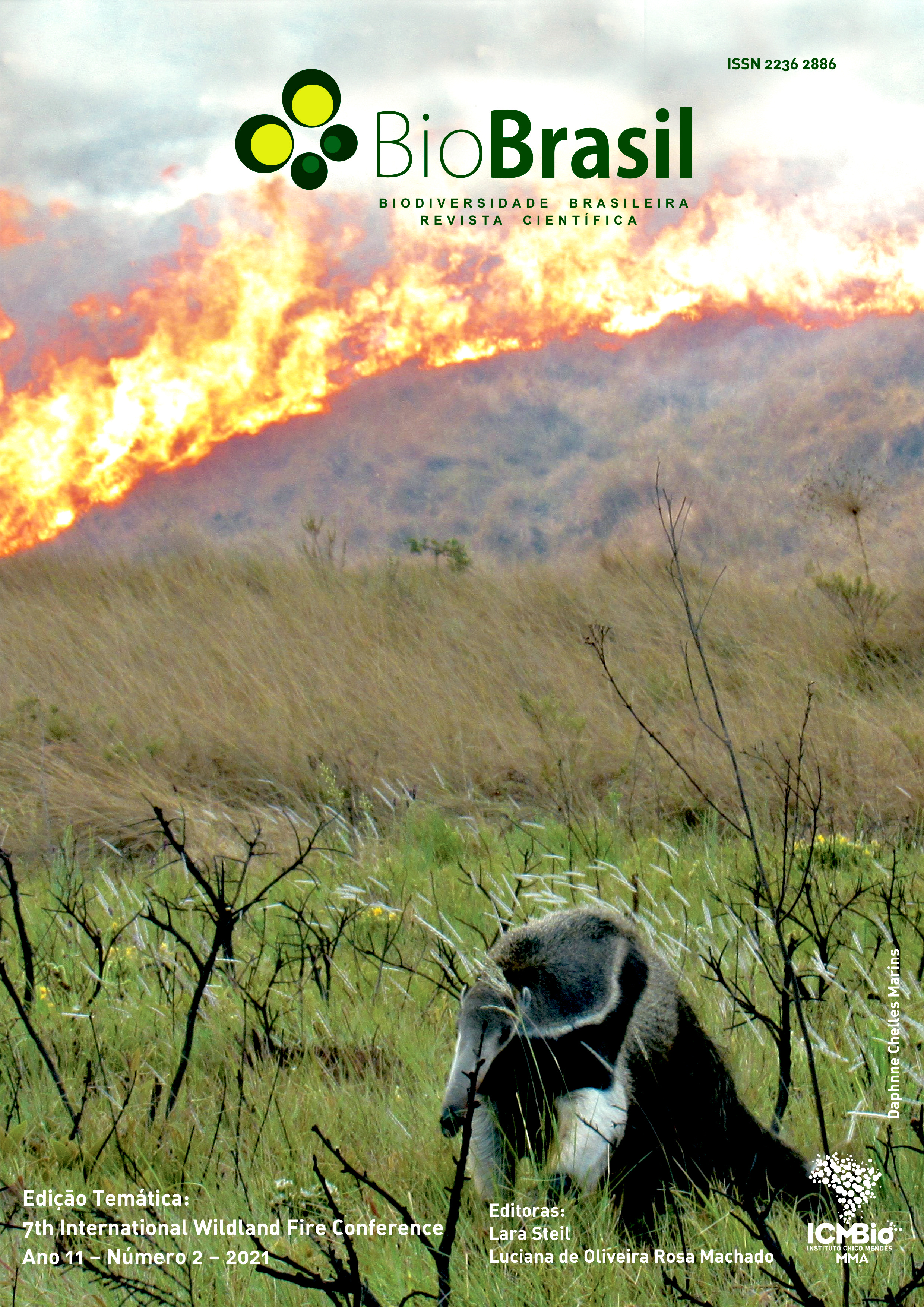
Sustainable fire management of remnant Cerrado (savanna) vegetation faces many challenges in Brazil and regionally, including: the legacy of imposed colonial fire suppression policies; massive fragmentation of the Cerrado biome through agricultural and pastoral development; loss of cultural fire management knowledge and experience; occurrence of severe late dry season wildfires given general lack of appropriate prescribed fire management. As context for addressing these challenges, we first provide illustrative examples of a successful market-based program implemented in fire-prone north Australian savannas, and recent establishment of a complementary pilot program in wildfire-prone savanna in Botswana. We then outline the need and opportunity for developing an analogous fire management approach in Brazilian Cerrado, noting that: (a) there is considerable potential for implementing supportive and incentivized fire management on frequently wildfireaffected lands, especially Indigenous Territories; (b) as demonstrated by Australian experience, such development can be achieved rapidly under conducive policy conditions. Perhaps the key to such rapid transformation is to recognise that everyone benefits - global climates, regional ecological sustainability, and local people both culturally and financially. The paper provides a contextual summary of presentations and technical workshop discussions associated with the conducting of a Special Session of the 7th International Wildland Fire Conference, Campo Grande, Brazil, focused broadly on the theme described by this paper's title.
Downloads
References
Ansell J et al. Contemporary Aboriginal savanna burning projects in Arnhem Land: a regional description and analysis of the fire management aspirations of Traditional Owners. International Journal of Wildland Fire, 29: 371-385, 2020. DOI: https://doi.org/10.1071/WF18152
Bowman DMJS & Panton WJ. Decline of Callitris intratropica in the Northern Territory: implications for pre- and post-colonisation fire regimes. Journal of Biogeography, 20: 373-381, 1993. DOI: https://doi.org/10.2307/2845586
CoA (Commonwealth of Australia). Carbon Credits (Carbon Farming Initiative) Reduction of Greenhouse Gas Emissions through Early Dry Season Savanna Burning. Methodology Determination 2013. Australian Government. <http://www.comlaw.gov.au/Series/F2013L01165>. 2013.
CoA (Commonwealth of Australia). Carbon Credits (Carbon Farming Initiative - Emissions Abatement through Savanna Fire Management) Methodology Determination 2015. Canberra: ComLaw, Australian Government. <http://www.comlaw.gov.au/Details/F2015L00344>. 2015.
CoA (Commonwealth of Australia). Carbon Credits (Carbon Farming Initiative - Savanna Fire Management - Emissions Avoidance) Methodology Determination 2018. Department of Environment and Energy, Australian Government. < https://www.legislation.gov. au/Details/F2018L00560>.
Cook GD, Meyer CP, Muepu M & Liedloff AC. Dead organic matter and the dynamics of carbon and greenhouse gas emissions in frequently burnt savannas. International Journal of Wildland Fire, 25: 1252-1263, 2016. DOI: https://doi.org/10.1071/WF15218
DoEE (Department of Environment and Energy). Savanna fire management carbon farming framework. Commonwealth of Australia. . 2019.
Durigan G. Zero-fire: not possible nor desirable in the Cerrado of Brazil. Flora, 268: 151612, 2019. DOI: https://doi.org/10.1016/j.flora.2020.151612
Durigan G & Ratter JA. The need for a consistent fire policy for Cerrado conservation. Journal of Applied Ecology, 53: 11-15, 2016. DOI: https://doi.org/10.1111/1365-2664.12559
Schmidt IB et al. Fire management in the Brazilian Savanna: first steps and the way forward. Journal of Applied Ecology, 55: 2094-2101. 2018. DOI: https://doi.org/10.1111/1365-2664.13118
Silva LCR, Hoffmann WA, Rossatto DR, Haridasan M, Franco AC & Horwath WR. Can savannas become forests? A coupled analysis of nutrient stocks and fire thresholds in central Brazil. Plant and Soil, 373(1-2): 829-842, 2013. DOI: https://doi.org/10.1007/s11104-013-1822-x
Townsend SA & Douglas MM. The effect of a wildfire on stream water quality and catchment water yield in a tropical savanna excluded from fire for 10 years (Kakadu National Park, North Australia). Water Research, 38: 3051-3058, 2004. DOI: https://doi.org/10.1016/j.watres.2004.04.009
UNU (United Nations University). The global potential of Indigenous Fire Management. Institute of Advanced Studies, United Nations University, Tokyo. <http://i.unu.edu/media/tfm.unu.edu/news/2151/Final-ReportFindings-Regional-Feasibility-Assessments-ISFMI.pdf>.2015.
van der Werf et al. Global fire emissions estimates during 1997-2016. Earth System Science Data, 9: 697-720, 2017. DOI: https://doi.org/10.5194/essd-9-697-2017
Whitehead PJ, Russell-Smith J & Yates CP. Carbon markets and improved management of fire in north Australian savannas: identifying sites for productive targeting of emissions reductions. The Rangelands Journal, 36: 371-388, 2014. DOI: https://doi.org/10.1071/RJ13129
Woinarski JCZ, Williams RJ, Price O & Rankmore B. Landscapes without boundaries: wildlife and their environments in northern Australia. Wildlife Research, 32: 377-388, 2005. DOI: https://doi.org/10.1071/WR03008
Ziembicki MR et al. Stemming the tide: progress towards resolving the causes of decline and implementing management responses for the disappearing mammal fauna of northern Australia. Therya, 6: 169-225, 2015. DOI: https://doi.org/10.12933/therya-15-236
Downloads
Published
Issue
Section
License
Copyright (c) 2021

This work is licensed under a Creative Commons Attribution-NonCommercial-NoDerivatives 4.0 International License.

This work is licensed under a Creative Commons Attribution-NonCommercial-NoDerivatives 4.0 International License.
The authors retain copyright to the published works, which may be reused and disseminated in other media, provided that the original publication source (Biodiversidade Brasileira journal) is cited.