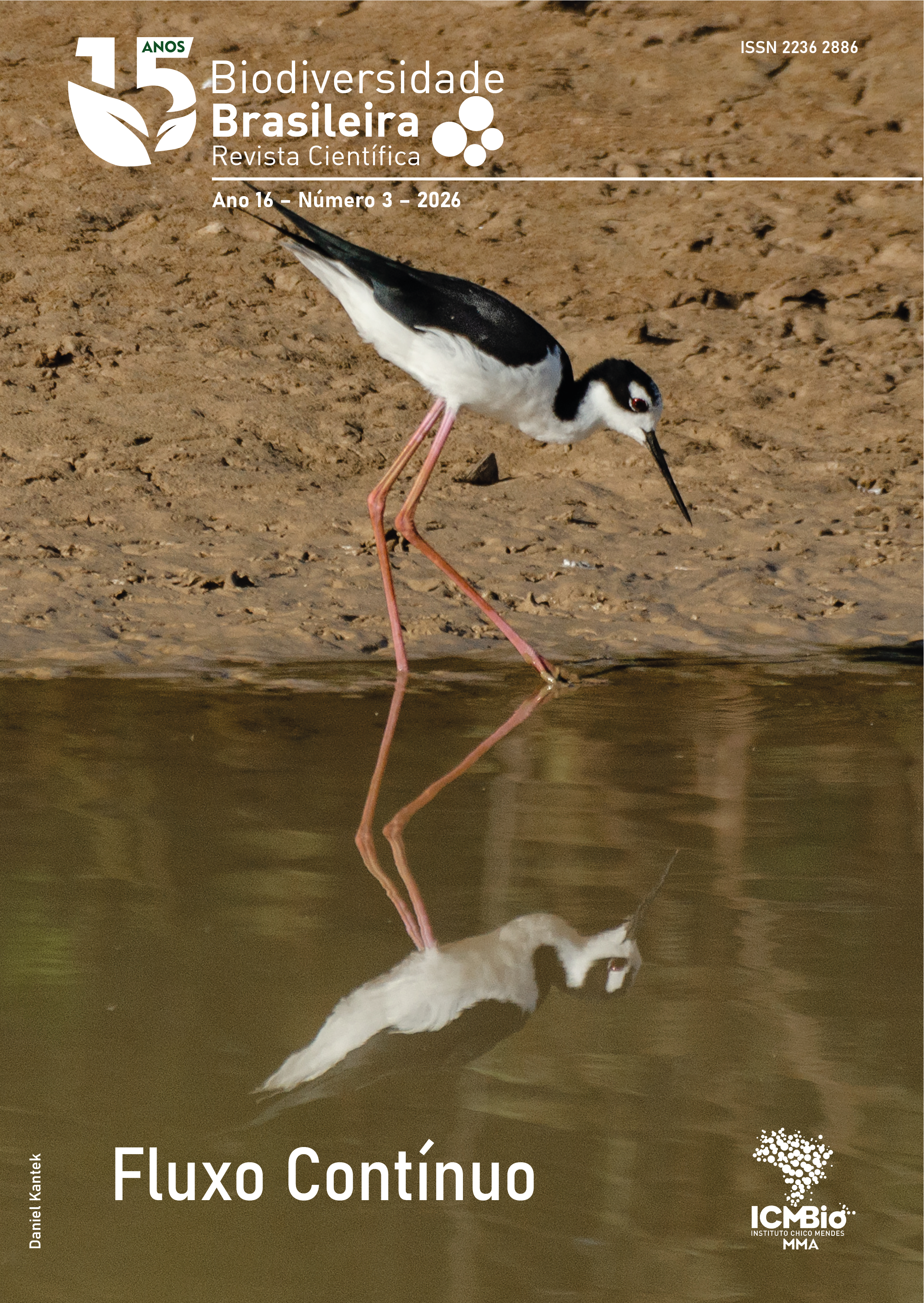
Distribución y uso del habitat por las aves acuáticas en una isla fluvial del municipio de Marabá, sudeste del estado de Pará
DOI:
https://doi.org/10.37002/biodiversidadebrasileira.v16i3.2867Palabras clave:
ecología del comportamiento, aves, ambientes acuáticosResumen
La cuenca del Amazonas alberga paisajes específicos como islas fluviales, bancos de arena que sustentan especies de aves acuáticas, pero que han sido explotados y afectados por diferentes actividades antropogénicas. En la isla de Tucunaré, en el municipio de Marabá, Pará, se designaron cuatro zonas con grados crecientes de actividades antropogénicas (por ejemplo, ocupación humana, iluminación artificial, impacto acústico) y composición ambiental, como suelo arenoso y parches de vegetación. En cada zona, se establecieron cuatro puntos a una distancia mínima de 300 metros entre sí. En cada punto se muestrearon la riqueza y la abundancia de aves acuáticas durante 45 minutos, así como el comportamiento de las aves, dividido en búsqueda de alimento, descanso y socialización, mediante muestreo de barrido, registrando estos comportamientos cada 5 minutos. Los datos de abundancia no mostraron diferencias entre las zonas, mientras que los datos de riqueza mostraron una diferencia entre las tres primeras zonas (con mayor antropización) y la cuarta, aunque la tercera y la cuarta zonas mostraron promedios similares (tres especies). La similitud en la composición de las aves mostró una mayor proximidad entre las zonas I y II, seguida de la zona III y, por último, la zona IV. Existen comportamientos más representativos por zona: búsqueda de alimento en la zona I, descanso en las zonas II y III y un equilibrio entre búsqueda de alimento y socialización en la zona IV. Nuestros datos indican que algunas aves son resistentes a los impactos antropogénicos, pero que la influencia humana tiene un impacto negativo en su uso del habitat.
Descargas
Citas
1. Guayasamin JM, Ribas CC, Carnaval AC, Carrillo JD, Hoorn C, Lohmann LG, et al. Evolution of Amazonian biodiversity: a review. Acta Amaz. 2024; 54(spe1): e54bc21360. doi: 10.1590/1809-4392202103601 DOI: https://doi.org/10.1590/1809-4392202103601
2. Antonelli A, Zizka A, Carvalho FA, Scharn R, Bacon CD, Silvestro D, et al. Amazonia is the primary source of Neotropical biodiversity. Proc Natl Acad Sci. Jun 2018; 115(23): 6034–9. doi: 10.1073/pnas.1713819115 DOI: https://doi.org/10.1073/pnas.1713819115
3. Alsbach CME, Seijmonsbergen AC, Hoorn C. Geodiversity in the Amazon drainage basin. Philos Trans R Soc Math Phys Eng Sci. Apr 2024; 382(2269): 20230065. doi: 10.1098/rsta.2023.0065 DOI: https://doi.org/10.1098/rsta.2023.0065
4. Cardozo M, Diniz BM, Szlafsztein CF. Os serviços ecossistêmicos dos recursos hídricos da Bacia Amazônica como Bens Públicos Globais. Agua Territ Water Landsc. Jun 2022; (21). doi: 10.17561/at.21.5609 DOI: https://doi.org/10.17561/at.21.5609
5. Latrubesse EM, Stevaux J. Geomorphology and environmental aspects of the Araguaia fluvial basin, Brazil. Z Für Geomorphol. Jan 2002; (129): 109–27.
6. Ribeiro MCLDB, Petrere M, Juras AA. Ecological integrity and fisheries ecology of the Araguaia—Tocantins River Basin, Brazil. Regul Rivers Res Manag. Nov 1995; 11(3–4): 325–50. doi: 10.1002/rrr.3450110308 DOI: https://doi.org/10.1002/rrr.3450110308
7. De Paiva RCD, Buarque DC, Collischonn W, Bonnet M, Frappart F, Calmant S, et al. Large‐scale hydrologic and hydrodynamic modeling of the Amazon River basin. Water Resour Res. Mar 2013; 49(3): 1226–43. doi: 10.1002/wrcr.20067 DOI: https://doi.org/10.1002/wrcr.20067
8. Reis V, Hermoso V, Hamilton SK, Bunn SE, Fluet‐Chouinard E, Venables B, et al. Characterizing seasonal dynamics of Amazonian wetlands for conservation and decision making. Aquat Conserv Mar Freshw Ecosyst. Jul 2019; 29(7): 1073–82. doi: 10.1002/aqc.3051 DOI: https://doi.org/10.1002/aqc.3051
9. Brusatte SL, O’Connor JK, Jarvis ED. The Origin and Diversification of Birds. Curr Biol. Oct 2015; 25(19): R888–98. doi: 10.1016/j.cub.2015.08.003 DOI: https://doi.org/10.1016/j.cub.2015.08.003
10. Amano T, Székely T, Sandel B, Nagy S, Mundkur T, Langendoen T, et al. Successful conservation of global waterbird populations depends on effective governance. Nature. Jan 2018; 553(7687): 199–202. doi: 10.1038/nature25139 DOI: https://doi.org/10.1038/nature25139
11. Accordi IA. Pesquisa e conservação de aves em áreas úmidas. Em: Ornitologia e Conservação: Ciência Aplicada, Técnicas de Pesquisa e Levantamento. 1o ed. Rio de Janeiro: Technical Books Editora; 2010. p. 189–216.
12. Cintra R. Spatial distribution and composition of waterbirds in relation to limnological conditions in the Amazon basin. Hydrobiologia. Mar 2015; 747(1): 235–52. doi: 10.1007/s10750-014-2148-2 DOI: https://doi.org/10.1007/s10750-014-2148-2
13. Green AJ. The importance of waterbirds as an overlooked pathway of invasion for alien species. Essl F, organizador. Divers Distrib. Feb 2016; 22(2): 239–47. doi: 10.1111/ddi.12392 DOI: https://doi.org/10.1111/ddi.12392
14. Green AJ, Jenkins KM, Bell D, Morris PJ, Kingsford RT. The potential role of waterbirds in dispersing invertebrates and plants in arid Australia. Freshw Biol. Feb 2008; 53(2): 380–92. doi: 10.1111/j.1365-2427.2007.01901.x DOI: https://doi.org/10.1111/j.1365-2427.2007.01901.x
15. Green AJ, Figuerola J, Sánchez MI. Implications of waterbird ecology for the dispersal of aquatic organisms. Acta Oecologica. Jun 2002; 23(3): 177–89. doi: 10.1016/S1146-609X(02)01149-9 DOI: https://doi.org/10.1016/S1146-609X(02)01149-9
16. Szabó B, Szabó A, Vad CF, Boros E, Lukić D, Ptacnik R, et al. Microbial stowaways: Waterbirds as dispersal vectors of aquatic pro‐ and microeukaryotic communities. J Biogeogr. Jul 2022; 49(7): 1286–98. doi: 10.1111/jbi.14381 DOI: https://doi.org/10.1111/jbi.14381
17. Green AJ, Elmberg J. Ecosystem services provided by waterbirds. Biol Rev. Feb 2014; 89(1): 105–22. doi: 10.1111/brv.12045 DOI: https://doi.org/10.1111/brv.12045
18. Batista IMDS, Miranda LM. Os “Hidronegócios” nos rios da Amazônia. Rev Bras História. Aug 2019; 39(81): 117–39. doi: 10.1590/1806-93472019v39n81-06 DOI: https://doi.org/10.1590/1806-93472019v39n81-06
19. Fearnside PM. Environmental Impacts of Brazil’s Tucuruí Dam: Unlearned Lessons for Hydroelectric Development in Amazonia. Environ Manage. Mar 2001; 27(3): 377–96. doi: 10.1007/s002670010156 DOI: https://doi.org/10.1007/s002670010156
20. Keddy PA, Fraser LH, Solomeshch AI, Junk WJ, Campbell DR, Arroyo MTK, et al. Wet and Wonderful: The World’s Largest Wetlands Are Conservation Priorities. BioScience. Jan 2009; 59(1): 39–51. doi: 10.1525/bio.2009.59.1.8 DOI: https://doi.org/10.1525/bio.2009.59.1.8
21. Rubert B, Branco JO, Barrilli GHC, Melo DC, Ferreira AP. Behavioral aspects of waterbirds. Braz J Biol. Feb 2021; 81(1): 164–77. doi: 10.1590/1519-6984.225048 DOI: https://doi.org/10.1590/1519-6984.225048
22. Pelicice FM, Agostinho AA, Akama A, Andrade Filho JD, Azevedo-Santos VM, Barbosa MVM, et al. Large-scale Degradation of the Tocantins-Araguaia River Basin. Environ Manage. Oct 2021; 68(4): 445–52. doi: 10.1007/s00267-021-01513-7 DOI: https://doi.org/10.1007/s00267-021-01513-7
23. Lima RC, Freitas AO, Barbosa LA, Gaia Neto RDS, Ramos SLF, Batista JDS. Indications that fishers perceive socio-environmental problems related to hydroelectric plants in the Tocantins river, Brazil. Braz J Health Rev. Jan 2024; 7(1): 2542–64. doi: 10.34119/bjhrv7n1-205 DOI: https://doi.org/10.34119/bjhrv7n1-205
24. Serrao L, Brentari L, Balcazar Terrones LE, Huamaní Yupanqui HA, Rengifo Trigoso JP, Zolezzi G. Hydro‐Morphological Disturbance and Suitability for Temporary Agriculture of Riverine Islands in a Tropical Wandering River. Water Resour Res. Feb 2022; 58(2): e2021WR030674. doi: 10.1029/2021WR030674 DOI: https://doi.org/10.1029/2021WR030674
25. Fearnside PM. Brazil’s Samuel Dam: Lessons for Hydroelectric Development Policy and the Environment in Amazonia. Environ Manage. Jan 2005; 35(1): 1–19. doi: 10.1007/s00267-004-0100-3 DOI: https://doi.org/10.1007/s00267-004-0100-3
26. De Jesus Diniz P, Baccaro FB, Borges SH. Taxonomic and functional structure of understorey bird assemblages on Amazonian seasonally flooded river islands. Biol J Linn Soc. Dec 2023; 140(4): 621–36. doi: 10.1093/biolinnean/blad083 DOI: https://doi.org/10.1093/biolinnean/blad083
27. Junk WJ. The flood pulse concept of large rivers: learning from the tropics. SIL Proc 1922-2010. Sep 2001; 27(7): 3950–3. doi: 10.1080/03680770.1998.11901733 DOI: https://doi.org/10.1080/03680770.1998.11901733
28. Timpe K, Kaplan D. The changing hydrology of a dammed Amazon. Sci Adv. Nov 2017; 3(11): e1700611. doi: 10.1126/sciadv.1700611 DOI: https://doi.org/10.1126/sciadv.1700611
29. Petry I, Fan FM, Siqueira VA, Collishonn W, De Paiva RCD, Quedi E, et al. Seasonal streamflow forecasting in South America’s largest rivers. J Hydrol Reg Stud. Oct 2023; 49: 101487. doi: 10.1016/j.ejrh.2023.101487 DOI: https://doi.org/10.1016/j.ejrh.2023.101487
30. Alvares CA, Stape JL, Sentelhas PC, De Moraes Gonçalves JL, Sparovek G. Köppen’s climate classification map for Brazil. Meteorol Z. Dec 2013; 22(6): 711–28. doi: 10.1127/0941-2948/2013/0507 DOI: https://doi.org/10.1127/0941-2948/2013/0507
31. Instituto Nacional de Metereologia. Mapa das estações [Internet]. [citado 18 de fevereiro de 2025]. Disponível em: https://mapas.inmet.gov.br/
32. Pacheco JF, Silveira LF, Aleixo A, Agne CE, Bencke GA, Bravo GA, et al. Annotated checklist of the birds of Brazil by the Brazilian Ornithological Records Committee—second edition. Ornithol Res. Jun 2021;29 (2): 94–105. doi: 10.1007/s43388-021-00058-x DOI: https://doi.org/10.1007/s43388-021-00058-x
33. Clements JF, Rasmussen PC, Schulenberg TS, Iliff MJ, Fredericks TA, Gerbracht JA, et al. The eBird/Clements checklist of Birds of the World [Internet]. Cornell Lab; 2024. Disponível em: https://www.birds.cornell.edu/clementschecklist/download/
34. Mitchell SL, Edwards DP, Martin RW, Deere NJ, Voigt M, Kastanya A, et al. Severity of deforestation mediates biotic homogenisation in an island archipelago. Ecography. Jul 2022; 2022(7): e05990. doi: 10.1111/ecog.05990 DOI: https://doi.org/10.1111/ecog.05990
35. Lishawa SC, Dunton EM, Pearsall DR, Monks AM, Himmler KB, Carson BD, et al. Wetland Waterbird Food Resources Increased by Harvesting Invasive Cattails. J Wildl Manag. Sep 2020; 84(7): 1326–37. doi: 10.1002/jwmg.21912 DOI: https://doi.org/10.1002/jwmg.21912
36. Wang C, Wang G, Dai L, Liu H, Li Y, Zhou Y, et al. Diverse usage of waterbird habitats and spatial management in Yancheng coastal wetlands. Ecol Indic. Oct 2020; 117: 106583. doi: 10.1016/j.ecolind.2020.106583 DOI: https://doi.org/10.1016/j.ecolind.2020.106583
37. Yasué M. The effects of human presence, flock size and prey density on shorebird foraging rates. J Ethol. Jul 2005; 23(2): 199–204. doi: 10.1007/s10164-005-0152-8 DOI: https://doi.org/10.1007/s10164-005-0152-8
38. Navarro R, Leal S, Marín G, Bastidas L. Anidación de cinco especies de aves acuáticas Charadriiformes en bancos aluviales del Río Orinoco. Saber. 2011; 23(1): 13–7.
39. Causey D, Padula VM. The Pelecaniform Birds. Em: Encyclopedia of Ocean Sciences [Internet]. Elsevier; 2019 [citado 29 de abril de 2026]. p. 119–28. Disponível em: https://linkinghub.elsevier.com/retrieve/pii/B9780124095489091272 doi: 10.1016/B978-0-12-409548-9.09127-2 DOI: https://doi.org/10.1016/B978-0-12-409548-9.09127-2
40. Woodall PF. Morphometry, diet and habitat in the kingfishers (Aves: Alcedinidae). J Zool. Jan 1991; 223(1): 79–90. DOI: https://doi.org/10.1111/j.1469-7998.1991.tb04750.x
41. D Zarza R, Cintra R, Anciäes M. Distribution, Abundance and Habitat Selection by Breeding Yellow-billed Terns (Sternula superciliaris), Large-Billed Terns (Phaetusa simplex) and Black Skimmers (Rynchops niger) in the Brazilian Amazon. Waterbirds. Dec 2013; 36(4): 470–81. doi: 10.1675/063.036.0404 DOI: https://doi.org/10.1675/063.036.0404
42. Gouvêa AC, Bravo GA, Antas PDTZ, Schuchmann KL, Silveira LF. Rainy cycles in South America as a driver for the breeding of the Black Skimmer (Rynchops niger) and the Large-billed Tern (Phaetusa simplex) (Aves, Charadriiformes). Papéis Avulsos Zool. Sep 2023; 63: e202363028. doi: 10.11606/1807-0205/2023.63.028 DOI: https://doi.org/10.11606/1807-0205/2023.63.028
43. Zhai Z, Liu S, Li Z, Ma R, Ge X, Feng H, et al. The spatiotemporal distribution patterns and impact factors of bird species richness: A case study of urban built-up areas in Beijing, China. Ecol Indic. Dec 2024; 169: 112847. doi: 10.1016/j.ecolind.2024.112847 DOI: https://doi.org/10.1016/j.ecolind.2024.112847
44. Cunningham JA, Kesler DC, Lanctot RB. Habitat and social factors influence nest-site selection in Arctic-breeding shorebirds. The Auk. Jul 2016; 133(3): 364–77. doi: 10.1642/AUK-15-196.1 DOI: https://doi.org/10.1642/AUK-15-196.1
45. Vargas Soto JS, Beirne C, Whitworth A, Cruz Diaz JC, Flatt E, Pillco‐Huarcaya R, et al. Human disturbance and shifts in vertebrate community composition in a biodiversity hotspot. Conserv Biol. Apr 2022; 36(2): e13813. doi: 10.1111/cobi.13813 DOI: https://doi.org/10.1111/cobi.13813
46. Wei Z, Zheng M, Zhou L, Xu W. Flexible Foraging Response of Wintering Hooded Cranes (Grus monacha) to Food Availability in the Lakes of the Yangtze River Floodplain, China. Animals. Mar 2020; 10(4): 568. doi: 10.3390/ani10040568 DOI: https://doi.org/10.3390/ani10040568
47. Matuoka MA, Benchimol M, Almeida-Rocha JMD, Morante-Filho JC. Effects of anthropogenic disturbances on bird functional diversity: A global meta-analysis. Ecol Indic. Sep 2020; 116: 106471. doi: 10.1016/j.ecolind.2020.106471 DOI: https://doi.org/10.1016/j.ecolind.2020.106471
48. Jetz W, Thomas GH, Joy JB, Hartmann K, Mooers AO. The global diversity of birds in space and time. Nature. Nov 2012; 491(7424): 444–8. doi: 10.1038/nature11631 DOI: https://doi.org/10.1038/nature11631
49. Cardoni DA, Favero M, Isacch JP. Recreational activities affecting the habitat use by birds in Pampa’s wetlands, Argentina: Implications for waterbird conservation. Biol Conserv. Mar 2008; 141(3): 797–806. doi: 10.1016/j.biocon.2007.12.024 DOI: https://doi.org/10.1016/j.biocon.2007.12.024
50. Schuh MH, Guadagnin DL. Habitat and landscape factors associated with the nestedness of waterbird assemblages and wetland habitats in South Brazil. Austral Ecol. Dec 2018; 43(8): 989–99. doi: 10.1111/aec.12648 DOI: https://doi.org/10.1111/aec.12648
51. Callaghan CT, Major RE, Wilshire JH, Martin JM, Kingsford RT, Cornwell WK. Generalists are the most urban‐tolerant of birds: a phylogenetically controlled analysis of ecological and life history traits using a novel continuous measure of bird responses to urbanization. Oikos. Jun 2019; 128(6): 845–58. doi: 10.1111/oik.06158 DOI: https://doi.org/10.1111/oik.06158
52. Vaccaro AS, Filloy J. Factors underlying bird community assembly in anthropogenic habitats depend on the biome. Sci Rep. Nov 2022; 12(1): 19804. doi: 10.1038/s41598-022-24238-x DOI: https://doi.org/10.1038/s41598-022-24238-x
Descargas
Publicado
Número
Sección
Licencia
Derechos de autor 2026 Flora Marya de Lima Bispo , André Vinícius Alves Nava , Maria Welida dos Santos Souza, Juliana Moraes Ferreira , Clarissa Mendes Knoechelmann , Felipe Fernando da Silva Siqueira

Esta obra está bajo una licencia internacional Creative Commons Atribución-NoComercial 4.0.

Esta obra está licenciada bajo la licencia Creative Commons Atribución-NoComercial-SinObraDerivada 4.0 Internacional.
Los autores conservan los derechos de autor de las obras publicadas, que pueden reutilizarse y difundirse en otros medios, siempre que se cite la fuente original de la publicación (revista Biodiversidade Brasileira).