The advance in land use in Rio Grande do Sul in the areas of occurrence of Araucaria angustifolia (Bertol.) Kuntze over time
DOI:
https://doi.org/10.37002/biodiversidadebrasileira.v15i2.2604Keywords:
Agriculture , land use and land cover, native vegetationAbstract
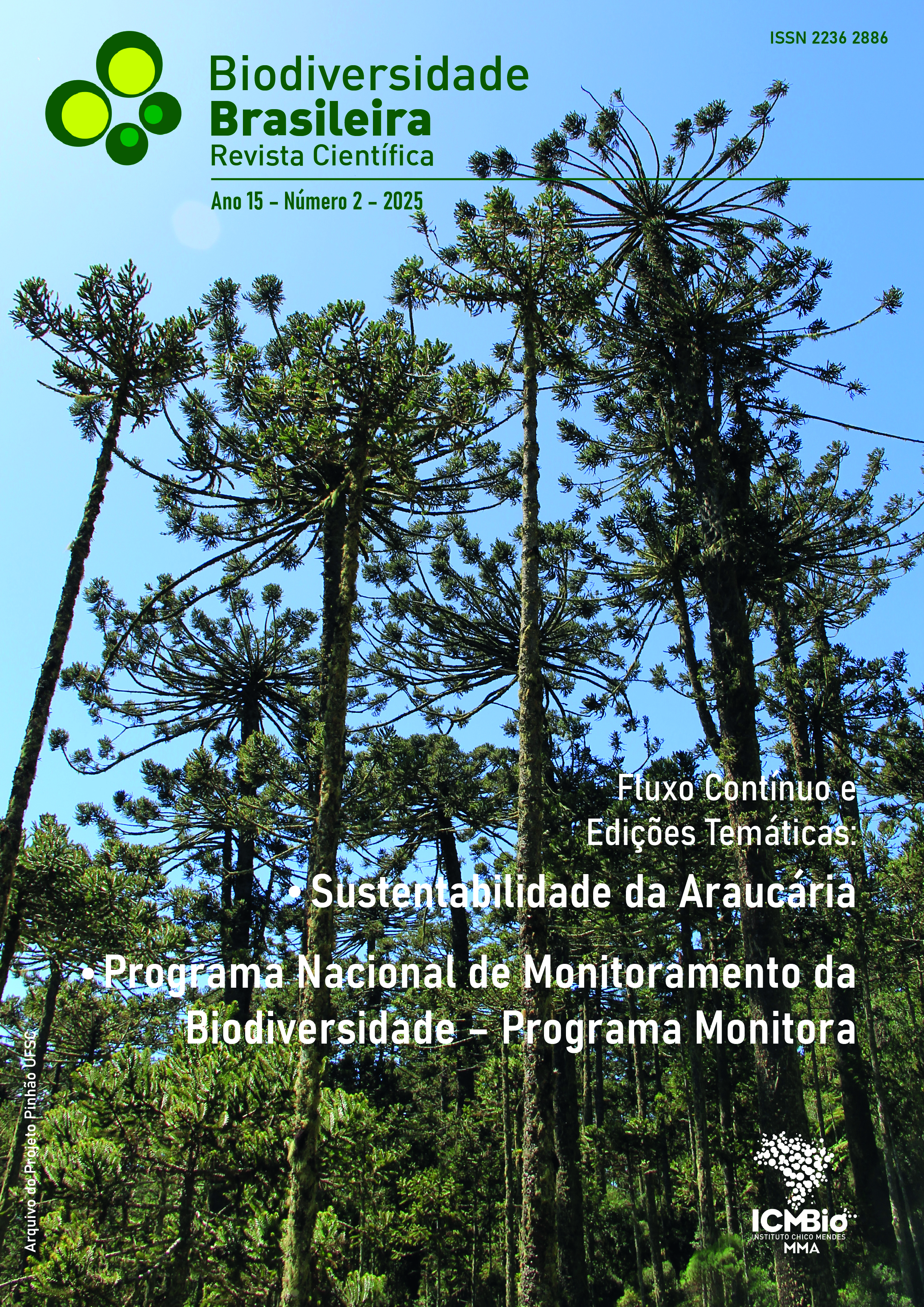
The mixed ombrophilous forest, dominated by the gymnosperm Araucaria angustifolia, is a typical formation of the Atlantic Forest in Rio Grande do Sul. Considered a key species, A. angustifolia sustains the ecosystem by providing resources for fauna and serving as a source of income. However, it is classified as Critically Endangered (CR) by the IUCN, threatened by habitat loss and illegal logging. Land use in the state forms a mosaic of grassland vegetation and forests, but in recent decades, land conversion has advanced over A. angustifolia areas, making the species' populations increasingly smaller and more isolated.This study assessed this expansion over the last 30 years using MapBiomas data. The results indicate significant changes, especially the conversion of natural areas into agriculture and livestock farming. While in the past native vegetation covered 25% of the state, today only 3.5% remains. Agriculture and livestock now occupy more than half of the territory, endangering the species’ remaining populations. Given this challenge, it is essential to seek strategies that reconcile conservation and the sustainable use of natural resources. Alternatives include promoting sustainable extractivism, strengthening enforcement efforts, and using satellite monitoring to track vegetation loss.
Downloads
References
1. Myers N, Mittermeier RA, Mittermeier CG, Fonseca GAB, Kent J. Biodiversity hotspots for conservation priorities. Nature. 2003; 403: 853-858. doi: 10.1038/35002501 DOI: https://doi.org/10.1038/35002501
2. Fundação SOS Mata Atlântica e INPE [internet]. Mata Atlântica [acesso em 10 jan 2025]. Disponível em: https://www.sosma.org.br/
3. Instituto Brasileiro de Geografia e Estatística. Manual Técnico da Vegetação Brasileira [internet]. Rio de Janeiro: IBGE; 2012. [citado em jan 2025]. Disponível: https://edisciplinas.usp.br/pluginfile.php/4228241/mod_resource/content/2/Manual%20Tecnico%20da%20Vegetacao%20Brasileira%20-%202012.pdf
4. Bogoni JA, Tagliari MM, Peroni N, Peres CA. Testing the keystone plant resource role of a flagship subtropical tree species (Araucaria angustifolia) in the Brazilian Atlantic Forest. Ecol Indic. 2020; 118(11): 106778. doi: 10.1016/j.ecolind.2020.106778 DOI: https://doi.org/10.1016/j.ecolind.2020.106778
5. Tagliari, MM, Vieilledent G, Alves J, Silveira TCL, Peroni N. Relict populations of Araucaria angustifolia will be isolated, poorly protected, and unconnected under climate and land‑use change in Brazil. Biodivers Conserv. 2021 agost; (30):3665-3684. doi: 10.1007/s10531-021-02270-z DOI: https://doi.org/10.1007/s10531-021-02270-z
6. Narvaes IS, Brena DA, Longhi SJ. Estrutura da regeneração natural na Floresta Ombrófila Mista na Floresta Nacional de São Francisco de Paula, RS. Cien Florest. 2005; 15(4): 331-342. doi: 10.5902/198050981871 DOI: https://doi.org/10.5902/198050981871
7. Wilson MC, et al. Habitat fragmentation and biodiversity conservation: key findings and future challenges. Landsc Ecol. 2016 Nov; (31): 219-227. doi: 10.1007/s10980-015-0312-3 DOI: https://doi.org/10.1007/s10980-015-0312-3
8. Forest F, Moat J, Baloch E, Brummitt NA, Bachman SP, Ickert-Bond S, Hollingsworth M, Liston A, Little DP, Mathews S, Rai H, Rydin C, Stevenson DW, Thomas P, Buerki S. Gymnosperms on the EDGE. Nature. 2018 abril; (8):6053. doi: 0.1038/s41598-018-24365-4 DOI: https://doi.org/10.1038/s41598-018-24365-4
9. Andrade BO. et al. 12.500+ and counting: biodiversity of the Brazilian Pampa. Front Biogeogr. 2023; 15(2). doi: 10.21425/F5FBG59288 DOI: https://doi.org/10.21425/F5FBG59288
10. Rambo B. A fisionomia do Rio Grande do Sul. Porto Alegre: Editora, 1960.
11. Behling H, Pillar VP, Orcoli L, Bauermann S. Late Quaternary Araucaria forest, grassland (Campos), fire and climate dynamics, studied by high-resolution pollen, charcoal and multivariate analysis of the Cambara do Sul core in southern Brazil. Palaeogeogr Palaeoclimatol Palaeoecol. 2004; 203(3): 277-297. doi: 10.1016/S0031-0182(03)00687-4 DOI: https://doi.org/10.1016/S0031-0182(03)00687-4
12. Behling H, Lichte M. Evidence of Dry and Cold Climatic Conditions at Glacial Times in Tropical Southeastern Brazil. Quat Res. 1997; 48(3): 348-358. doi: 10.1006/qres.1997.1932 DOI: https://doi.org/10.1006/qres.1997.1932
13. Projeto MapBiomas Coleção [8] da Série Anual de Mapas de Cobertura e Uso da Terra do Brasil [citado em marc 2024]; Disponível em: https://brasil.mapbiomas.org/faq/como-faco-para-citar-os-dados-do-mapbiomas/#6
14. Behling H, Verissimo N, Bauermann SG, Bordignon S, Evaldt A. Late Holocene Vegetation History and Early Evidence of Araucaria angustifolia in Caçapava do Sul in the Lowland Region of Rio Grande do Sul State, Southern Brazil. Braz Arch Biol Technol. 2016; 59. doi: 10.1590/1678-4324-2016150264 DOI: https://doi.org/10.1590/1678-4324-2016150264
15. Santos S, Silva LG. Mapeamento por imagens de sensoriamento remoto evidencia o bioma pampa brasileiro sob ameaça. Bol Geogr. 2012; 29(2): 49-57. doi: 10.4025/bol geogr.v29i2.12366 DOI: https://doi.org/10.4025/bolgeogr.v29i2.12366
16. Hasenack H, Weber EJ, Boldrini II, Trevisan R, Flores CA, Dewes H. Biophysical delineation of grassland ecological systems in the State of Rio Grande do Sul, Southern Brazil. Iheringia. 2022; 78: e2023001. doi: 10.21826/2446-82312023v78e2023001 DOI: https://doi.org/10.21826/2446-82312023v78e2023001
17. Vieria EM, Iob G. Dispersão e predação de sementes da Araucária (Araucaria angustifolia). In: Fonseca CR, Souza AF, Leal-Zanchet AM, Dutra T, Backers A, Ganade G: Floresta de Araucária: Ecologia, Conservação e Desenvolvimento Sustentável. Ribeirão Preto: Editora Holos. 2009; 85-95.
18. Centro de Referência em Informação Ambiental. speciesLink [internet]. Sistema de Informação Distribuído para Coleções Biológicas [Acesso em abril 2024]. Disponível em: https://specieslink.net
19. Araucaria angustifolia (Bertol.) Kuntze in GBIF Secretariat. GBIF Backbone Taxonomy. Checklist dataset. 2023 [acesso em mai 2024]. Disponível em: https://www.gbif.org/pt/species/2684940.
20. Rstudio Team. RStudio: Integrated Development for R; RStudio, PBC: Boston, MA, USA, 2024. [citado em jan 2025]. Disponível em: http://www.rstudio.com/
21. Wickham H. ggplot2: Elegant Graphics for Data Analysis [internet]. Springer-Verlag, 2016 [acesso em jan 2025]. Disponível em: https://ggplot2.tidyverse.org
22. Pscheidt F, Higuchi P, Silva AC, Rech TD, Salami B, Ferreira TS, Bonazza M, Bento MA. Efeito de borda como fonte da heterogeneidade do componente arbóreo em uma floresta com araucárias no sul do Brasil. Cien Florest. 2018; 28(2): 601-612. doi:10.5902/1980509832046 DOI: https://doi.org/10.5902/1980509832046
23. Rocha LFB, Dias GF, Júnior FWA, Mello JM, Donizete AO, Scolforo JR. Inventários de fragmentos florestais nativos e propostas para seu manejo e o da paisagem. Cernes, Lavras. 2004; 10(1): 22-38
24. DeFries RS, Rudel T, Uriarte M, Hansen M. Deforestation driven by urban population growth and agricultural trade in the twenty-first century. Nat Geosci. 2010 Fev; 3:178-181. doi: 10.1038/NGEO756 DOI: https://doi.org/10.1038/ngeo756
25. Suarez A, Gwozdz W. On the relation between monocultures and ecosystem services in the Global South: A review. Biol Conserv. 2023 Fev; 278: 109870. doi: 10.1016/j.biocon.2022.109870 DOI: https://doi.org/10.1016/j.biocon.2022.109870
26. Dedo CAG, Costa EA, Hess AF, Liesenberg V, Bispo PC. Simulating Sustainable Forest Management Practices Using Crown Attributes: Insights for Araucaria angustifolia Trees in Southern Brazil. Forests. 2023 jun; 14(7): 1285. doi: 10.3390/f14071285 DOI: https://doi.org/10.3390/f14071285
27. Lindenmayer DB, Franklin JF, Fischer J. General management principles and a checklist of strategies to guide forest biodiversity conservation. Biol Conserv. 2006 agost;131(3): 433-445. doi: 10.1016/j.biocon.2006.02.019 DOI: https://doi.org/10.1016/j.biocon.2006.02.019
28. Ribeiro MC, Metzger JP, Martensen AC, Ponzoni FJ, Hitora MM. The Brazilian Atlantic Forest: How much is left, and how is the remaining forest distributed? Implications for conservation. Biol Conserv. 2009; 142(6): 1141-1153. doi: 10.1016/j.biocon.2009.02.021 DOI: https://doi.org/10.1016/j.biocon.2009.02.021
29. Brasil. Lei nº 12.651, de 25 de maio de 2012. Dispõe sobre a proteção da vegetação nativa. [internet] Diário Oficial da União. [citado em jan 2025]. Disponivel em: https://www.planalto.gov.br/ccivil_03/_ato2011-2014/2012/lei/L12651compilado.htm
30. Wilson OJ, Walters RJ, Mayle FE, Lingner DV, Vibrans AC. Cold spot microrefugia hold the key to survival for Brazil's Critically Endangered Araucaria tree. Glob Change Biol. 2019 Jun; 25(12):4339-4351. doi: 10.1111/gcb.14755 DOI: https://doi.org/10.1111/gcb.14755
31. Bernardinis GB, Cobos ME, Brum FT, Marques MCM, Peterson AT, Carlucci, Zwiener VP. Ecological restoration and protection of remnants are key to the survival of the critically endangered Araucaria tree under climate change. Glob Ecol Conserv. 2023 Nov; e02668. doi: 10.1016/j.gecco.2023.e02668 DOI: https://doi.org/10.1016/j.gecco.2023.e02668
32. Marchioro CA, Santos KL, Siminski A. Present and future of the critically endangered Araucaria angustifolia due to climate change and habitat loss. Forestry. 2019 Dez; 93(3): 401-410. doi: 10.1093/forestry/cpz066 DOI: https://doi.org/10.1093/forestry/cpz066
Published
Issue
Section
License
Copyright (c) 2025

This work is licensed under a Creative Commons Attribution-NonCommercial-NoDerivatives 4.0 International License.

This work is licensed under a Creative Commons Attribution-NonCommercial-NoDerivatives 4.0 International License.
The authors retain copyright to the published works, which may be reused and disseminated in other media, provided that the original publication source (Biodiversidade Brasileira journal) is cited.