The squirrel monkeys (Saimiri) of Mamirauá Reserve: from the species description to the consolidation of long-term research
DOI:
https://doi.org/10.37002/biodiversidadebrasileira.v7i2.623Keywords:
Floodplain forests , biogeography, conservation , geographic distribution , endemismAbstract
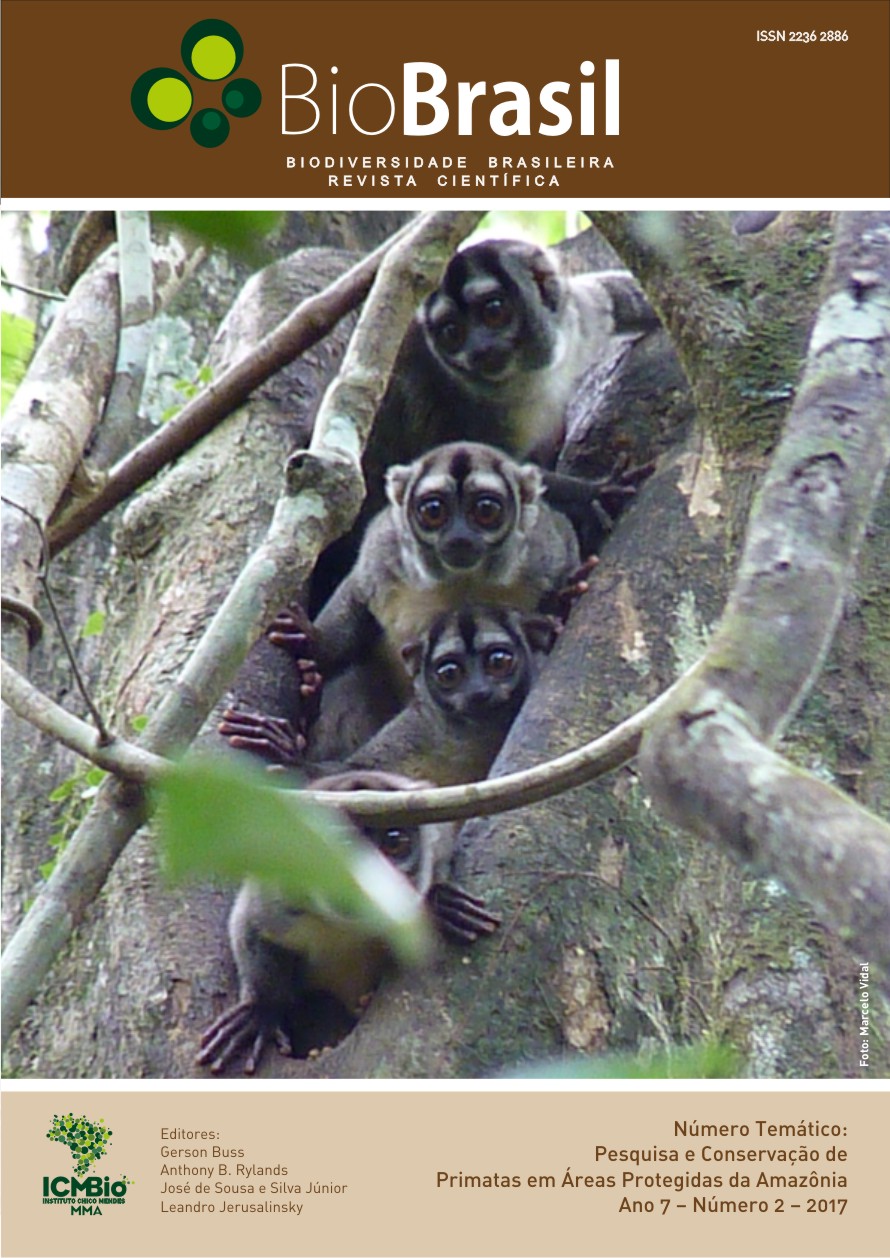
The Mamirauá Sustainable Development Reserve (MSDR) is the largest protected area dedicated to the conservation of biodiversity in floodplain forests. Primate richness there is one of the highest in an Amazonian protected area, but primatological studies are still incipient. The black-headed squirrel monkey (Saimiri vanzolinii) was described in 1985, but the first studies on the species only began more than two decades later. This ‘Vulnerable' species is endemic to the area, and its geographic distribution is only 870km². Two other squirrel monkeys (S. cassiquiarensis and S. macrodon) occur in the area, and have peripatric distributions with S. vanzolinii, including contact zones on the bordering regions. These peripatric species have large geographic distributions and their conservation status is "Least Concern". Phylogenetic studies have determined that the three Saimiri taxa are considered valid species. Bioacoustic and morphological analyses corroborated the previous study, demonstrating differentiation between the species. The main incentive for starting a long-term research was program was interest in investigating the reasons for S. vanzolinii's limited range. Aspects related to ecology, behavior, taxonomy, and phylogenetic and historical biogeography are essential to understand the current pattern of geographic distribution of the squirrel monkeys in Mamirauá. These aspects are also important in the planning of conservation strategies, especially for S. vanzolinii. Studies being conducted in the MSDR are focusing on the floristic communities comprising the ranges of these species, and availability of food sources and their presence in the diet. These questions will help us understand whether evolutionary processes, such as competitive exclusion, might be affecting S. vanzolinii and consequently contributing to its natural extinction process. The major concern about the species relates to climate change, with models indicating an increase in the intensity and frequency of flooding in the region of the middle Rio Solimões. Logging in the region may also be contributing to environmental changes. The association between these two factors could result in habitat loss for S. vanzolinii, increasing its risk of extinction. Management of ex situ breeding colonies of S. vanzolinii should be considered as an additional conservation strategy.
Downloads
Downloads
Published
Issue
Section
License
Copyright (c) 2018 Fernanda Pozzan Paim

This work is licensed under a Creative Commons Attribution-NonCommercial-NoDerivatives 4.0 International License.

This work is licensed under a Creative Commons Attribution-NonCommercial-NoDerivatives 4.0 International License.
The authors retain copyright to the published works, which may be reused and disseminated in other media, provided that the original publication source (Biodiversidade Brasileira journal) is cited.