Vol. 10 No. 2 (2020): Diálogos entre a Academia e a Gestão de Áreas Protegidas: Programa de Pós-Graduação Profissional
					View Vol. 10 No. 2 (2020): Diálogos entre a Academia e a Gestão de Áreas Protegidas: Programa de Pós-Graduação Profissional

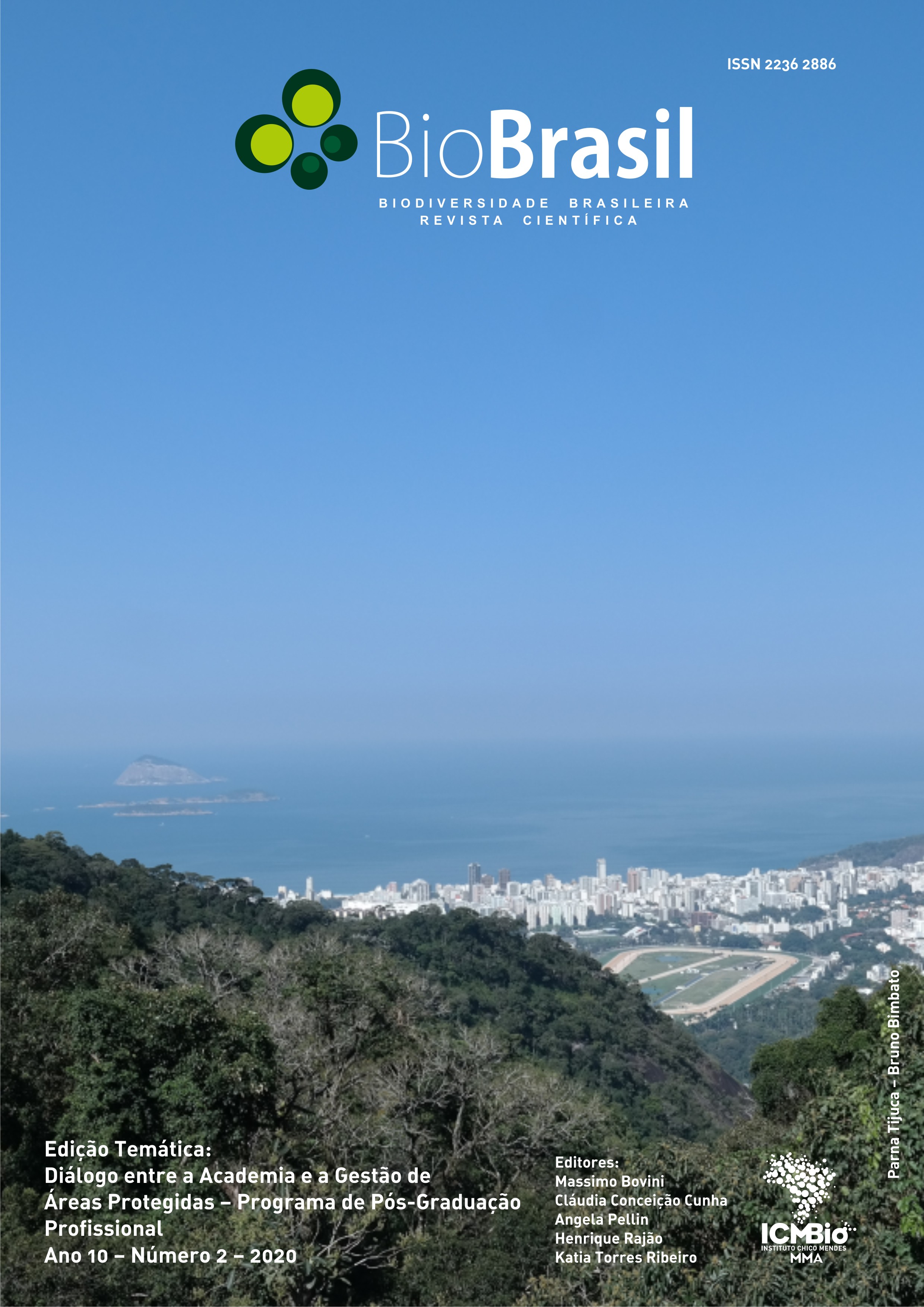
#ForEveryoneToSee: The cover image presents a stunning panoramic view of the city of Rio de Janeiro. In the foreground, there is dense Atlantic Forest vegetation seen from above, with trees in different shades of green. In the background, the city appears with numerous tall white buildings extending to the seashore. The ocean occupies much of the background, its blue tone blending with the clear sky, a deep blue without clouds. On the left side, small oceanic islands can be seen. At the top of the image, centered to the left, is the journal’s logo with dark green and yellow circles, followed by the title: “BioBrasil – Biodiversidade Brasileira – Scientific Journal.” In the upper right corner is the ISSN number: 2236-2886.
In the lower left, over the dark vegetation, appears the thematic edition text in white letters:
“Dialogue between Academia and Protected Area Management – Professional Graduate Program”
Year 10 – Number 2 – 2020. In the lower right, the editors are listed: Massimo Bovini, Cláudia Conceição Cunha, Ângela Pellin, Henrique Rajão, and Katia Torres Ribeiro. Just below is the ICMBio logo (Chico Mendes Institute for Biodiversity Conservation) together with the MMA – Ministry of the Environment mark. Along the right side, in a vertical position, appears the photo credit: Parna Tijuca – Bruno Bimbato.

Published: 2020-08-13

Diálogos entre a Academia e a Gestão de Áreas Protegidas: Programa de Pós-Graduação Profissional

  • Editorial

    Biodiversidade Brasileira
    1-3
    DOI: https://doi.org/10.37002/biobrasil.v10i2.1752
  • Environmental compensation used as a legalmechanism for the recovery of an urban forest in the state of Rio de Janeiro

    Danielle Trindade, Richieri Sartori, Marcia Botelho-Silva, Lygia Bicalho, Massimo G. Bovini
    4-16
    DOI: https://doi.org/10.37002/biobrasil.v10i2.1446
  • Possibility of using compensation mechanisms for land regularization of state conservation units in Minas Gerais

    Fernanda Teixeira Silva, Ana Paula Leite Prates
    17-35
    DOI: https://doi.org/10.37002/biobrasil.v10i2.1468
  • The selection of conservation areas in the Brazilian Atlantic forest review of studies for spatial prioritization

    Rosana Cristina Pezzi D'Arrigo, Maria Lucia Lorini, Henrique Rajão
    36-49
    DOI: https://doi.org/10.37002/biobrasil.v10i2.1462
  • Could protected areas in Brazil's semi-arid conserve endangered birds facing climatic and land cover changes?

    Tiago Castro Silva, Lara Gomes Côrtes, Marinez Ferreira Siqueira
    50-70
    DOI: https://doi.org/10.37002/biobrasil.v10i2.1469
  • Paradigms of Fire Management in Protected Areas in the World and the Case of the Serra Geral do Tocantins Ecological Station

    Ana Carolina Sena Barradas, Marco Assis Borges, Máximo Menezes Costa, Katia Torres Ribeiro
    71-86
    DOI: https://doi.org/10.37002/biobrasil.v10i2.1474
  • Reduction of Forest Fires in the Araras Biological Reserve, Rio de Janeiro, Southeast Brazil

    Fabio Torres Migliari, Izar Aximoff, Massimo G. Bovini
    87-95
    DOI: https://doi.org/10.37002/biobrasil.v10i2.1464
  • Cooperative Actions for the Prevention and Fighting of Forest Fires in an Urban Protected Area in the City of Rio de Janeiro

    Izar Araujo Aximoff, Luciano Araujo Menna Barreto, Bruno Coutinho Kurtz
    96-109
    DOI: https://doi.org/10.37002/biobrasil.v10i2.1448
  • Phytosociological and Environmental Analysis of a Rocky Outcrop Located in Caldas County, Minas Gerais State, Brazil.

    João Paulo de Lima Braga, Sarah França Andrade, Richieri Antonio Sartori
    110-120
    DOI: https://doi.org/10.37002/biobrasil.v10i2.1450
  • The Qualification of Educators on Restingas in the Region of Lagos/RJ Evaluation and Perspectives

    Fernanda Saleme, Maria do Rosário de Almeida Braga, Bruno Coutinho Kurtz
    121-132
    DOI: https://doi.org/10.37002/biobrasil.v10i2.1455
  • Domestic Animals and the Risk of Transmission of Pathogens for Wild Fauna in the Surrounding Area of Tijuca National Park

    Gabriela Heliodoro, Carlos Eduardo Verona, Henrique Rajão
    133-147
    DOI: https://doi.org/10.37002/biobrasil.v10i2.1463
  • Advance of Urochloa decumbens (Stapf) R.D. Webster (Poaceae) on remaining native forest in the Serra da BODOQUENA NATIONAL PARK

    José Guilherme Dias de Oliveira, Luiz Fernando Duarte de Moraes, Tânia Sampaio Pereira, Geraldo Alves Damasceno Junior
    148-157
    DOI: https://doi.org/10.37002/biobrasil.v10i2.1481
  • List, Spore Bank and Illustrated Guide to Ferns and Lycophytes of the Serra da Pedra Branca Biological Reserve, Caldas, Minas Gerais

    Eric Arruda Williams, Massimo G. Bovini, Claudine Massi Mynssen
    158-176
    DOI: https://doi.org/10.37002/biobrasil.v10i2.1454
  • Interpretative Trail of Ferns and Lycophytes in the Tijuca National Park, Rio de Janeiro

    Monira Bruno Bicalho, Claudine Massi Mynssen
    177-186
    DOI: https://doi.org/10.37002/biobrasil.v10i2.1453
  • Macroscopic and Microscopic Wood Identification of Itatiaia National Park: Interactive Key Developed in Free Software

    Thaís Feirreira Siston, Arno Fritz das Neves Brandes, Leonardo Bona, Gláucia Crispim, Alessandra Voigt, Claudia Franca Barros
    178-204
    DOI: https://doi.org/10.37002/biobrasil.v10i2.1460
  • Expediente

    Biodiversidade Brasileira
    205
    DOI: https://doi.org/10.37002/biobrasil.v10i2.1753